Answering the question most buyers ask: which vanity water supply lines balance durability, ease of installation, and compatibility? This guide highlights five braided stainless steel faucet hoses that fit common 3/8″ compression to 1/2″ FIP connections. These lines are best for replacing old hoses, upgrading to leak-tight connectors, and ensuring reliable water delivery for bathroom and kitchen faucets. Suitable for weekend DIYers and homeowners seeking long-lasting performance, these options cover a range of lengths and configurations.
Summary of selected products:
| Product | Length | Fittings | Best For | Limitations |
|---|---|---|---|---|
| [2-Pack] PROCURU 24-Inch (2Ft) x 3/8″ Comp x 1/2″ FIP | 24 in | 3/8″ Comp to 1/2″ FIP | Most bathroom/kitchen faucet connections | Pair package only; check valve compatibility |
| Midanya 24″ Stainless Steel Braided | 24 in | 3/8″ COMP to 1/2″ FIP | Durable replacement with corrosion-resistant fittings | Contains gaskets; install torque needed |
| [2-Pack] PROCURU 16-Inch | 16 in | 3/8″ Comp to 1/2″ FIP | Compact spaces; quick replacements | Short length may not fit every setup |
| [2-Pack] PROCURU 12-Inch | 12 in | 3/8″ Comp to 1/2″ FIP | Tight spaces; flexible routing | Very short; plan hose routing |
| KAINGA 30″ Faucet Supply Line | 30 in | 3/8″ Comp to 1/2″ FIP | Longer reach; versatile in kitchens and baths | Higher price than basic variants |
[2-Pack] PROCURU 24-Inch Faucet Hose Connectors

Best for the average bathroom or kitchen faucet where a standard 24-inch reach is needed. Inlet is 3/8″ Compression, connecting to a supply stop valve, with a 1/2″ FIP outlet for faucet connection. This item is ideal for homeowners seeking a straightforward, durable replacement that fits most common valve configurations. Caution: ensure the hose length matches the faucet location to avoid tension or kinks.
Midanya 24″ Stainless Steel Braided Lines

Best for users prioritizing corrosion resistance and long-term reliability. These 24″ lines use SUS304 stainless steel braid with solid fittings designed to resist wear and oxidation. Gaskets are included for seal precision. They are simple to install with basic tools and suitable for replacing aging hoses. Caution: ensure gasket compatibility with your existing fittings to minimize leaks.
PROCURU 16-Inch Stainless Steel Braided Line
Best for tight installations where space is limited. The 16″ length provides a compact option while maintaining a 3/8″ compression to 1/2″ FIP connection. This Procuru line is suitable for sinks with constrained under-sink spaces. Limitation: shorter length may require precise routing to avoid bending near the fittings.
PROCURU 12-Inch Stainless Steel Line
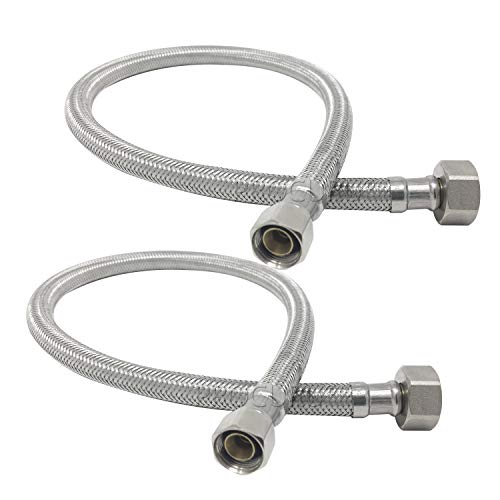
Best for very tight spaces or when a faucet sits close to the wall. The 12″ hose provides a flexible, compact solution with the common 3/8″ compression to 1/2″ FIP configuration. Choose this if your faucet location minimizes available hose length. Caution: ensure adequate clearance for valve rotation and nut tightening.
KAINGA 30″ Braided Faucet Supply Line

Best for installations requiring extra reach between fixtures and supply valves. The 30″ length supports longer runs without tension and is designed with braided stainless steel over a flexible PVC core for burst resistance. It features nickel-plated brass nuts with elastomeric gaskets for a secure seal. Limitation: may be overlong for compact under-sink spaces; plan routing accordingly.
EZ-Fluid 20″ Stainless Steel Line

Best for versatile kitchen and bathroom use with a universal 20″ length. It uses stainless steel braid and offers a lead-free, cUPC-certified option. The line is suitable for both hot and cold water with a 3/8″ compression to 1/2″ FIP connection. Caution: verify compatibility with your faucet’s inlet size and available space under the sink.
SUNGATOR 16 Inch Faucet Lines

Best for standard bathroom sinks where a mid-length hose is sufficient. The 16″ length includes nuts on both ends and comes with extra sealing tape and wrenches for installation. Caution: confirm total length needed before purchasing to avoid overhang or shortage.
PROCURU 36″ (3Ft) Braided Line

Best for long runs where the faucet is far from the shutoff valve. The 36″ length provides ample reach with a durable 3/8″ to 1/2″ FIP configuration. Consider this option when routing around obstacles under the sink. Caution: longer hoses may be more prone to bending if not properly supported.
Buying Guide: Key Considerations for Vanity Water Supply Lines
- Length: Measure the distance between your shutoff valve and faucet to prevent under-sink strain or slack. Longer hoses offer flexibility but can sag if not secured.
- Fittings: Most bathroom and kitchen faucets use 1/2″ FIP connections with 3/8″ compression supply valves. Confirm your valve type before purchase.
- Material: Stainless steel braided lines resist corrosion and wear; nylon or PVC cores with brass fittings are common. Look for lead-free and cUPC-certified options for safety.
- Leak prevention: Gaskets and elastomeric seals improve leak resistance. Ensure torque-optimized geometry on nuts to maintain a secure seal without over-tightening.
- Installation: Most lines install with basic hand tools; some include installation aids (wrenches/tape). If space is tight, choose shorter lengths and flexible routing.
- Durability vs cost: Premium braided lines typically last longer and resist kinking, but budget options can suffice if they meet required specifications.
Frequently Asked Questions
- What fittings do vanity supply lines use? Answer: Commonly 3/8″ compression on one end and 1/2″ FIP on the other.
- How long should I choose a supply line? Answer: Match length to the distance from valve to faucet, with a little extra for routing flexibility.
- Are braided lines safer than rubber hoses? Answer: Yes, braided stainless steel lines tend to resist wear and leaks better in typical home use.
- Do I need plumber’s tape? Answer: Some kits include sealing tape; otherwise, apply it to ensure a tight seal on thread connections.
- Can I install these myself? Answer: Most lines require only basic hand tools; follow the manufacturer’s instructions for torque and alignment.
- Which line is best for small under-sink spaces? Answer: Shorter lines, such as 12″ or 16″, are often easier to fit in tight spaces.