Stand-alone door alarms offer immediate, no-installation-needed protection for doors and entry points. This guide highlights reliable, battery-powered systems you can deploy without WiFi or professional installation. Each product below is selected for strong alert volumes, easy setup, and broad applicability—from apartments to small shops. The table after the intro provides a quick snapshot of the chosen options.
| Product | Brand | Type | Key Benefit |
|---|---|---|---|
| KERUI Standalone Home Security Kit | KERUI | Wireless Siren Kit | Up to 115 dB with motion and door sensors |
| EMDMAK Door Stop Alarm | EMDMAK | Door Stop Alarm | Dual function with door-stop and alarm |
| Detex Exit Alarm | Detex | Surface-Mounted Alarm | Standalone exit alarm with cover and keys |
| GE Personal Security Alarm (2-Pack) | GE | Wireless Door/Window Alarms | Two-pack for expansive coverage |
| Satisure Wireless Door Chime Alarm | Satisure | Door Sensor Alarm Chime | Low-maintenance, long-range notification |
In the following sections, each product is described with its main features and practical use cases. All descriptions rely on stated capabilities to help you compare options objectively.
KERUI Standalone Security Kit With 115dB Siren

The KERUI kit is a DIY, wireless security solution intended for doors, windows, and interior spaces. The main horn can reach loud levels up to 115 dB, which is suitable for apartments, shops, or small offices. The system supports up to 30 wireless detectors and multiple remotes, enabling flexible arming and monitoring. It includes sensors, multiple remotes, motion detectors, and a horn, all designed for a self-managed installation. The kit emphasizes a 6-second trigger window for sensor activation and notes reseating steps if you encounter setup issues. It is a practical all-in-one solution for a self-built home security perimeter.
What to consider: This is a DIY system, so confirm you’re comfortable programming the main unit and sensors. Its lack of WiFi or app means you’ll rely on the physical setup and remote controls for daily operation. Ideal for renters and homeowners who want a stand-alone alerting system without ongoing subscriptions.
Alarm Lock DL270026D Trilogy Stand-Alone Digital Lock

The DL2700/26D is a stand-alone digital lock featuring programmable entry codes for up to 100 users, offering secure keyless entry. It uses a fixed 6-pin key cylinder with a key override option and is appropriate for interior doors. The emphasis is on access control rather than siren alerts, making it a complementary component for properties requiring controlled entry alongside other alarm systems. Installations are typically on interior doors where electronic access is a priority, though its weatherproof variant extends use outdoors in some configurations.
What to consider: If you need a door lock with programmable codes and a simple override, this unit fits. It is not a full alarm system by itself, so pair it with a separate door alarm for comprehensive protection where needed.
KERUI Wireless Indoor Motion Sensor Door Bell

This standalone chime alarm combines motion detection with audible alerts up to 90 dB and a flashing red light. It’s suitable for shops, offices, or homes, alerting you to intruders or visitors when motion is detected near entryways. The device offers multiple operation modes, including voice and music options, with adjustable volume and curated melodies. Power options include a wall adapter or battery, allowing flexibility in placement away from outlets. It is designed for easy installation and user-friendly control, fitting well in commercial or small business settings.
What to consider: For locations needing motion-triggered alerts without a full security network, this device provides rapid notification. Battery power makes placement flexible, but you’ll want to ensure battery life meets your usage pattern.
EMDMAK Door Stop Alarm With 120dB Siren
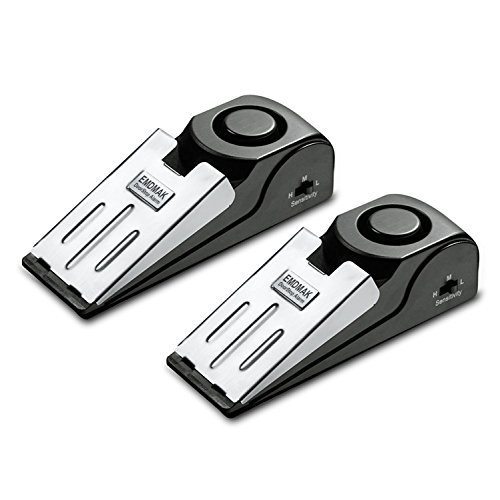
The EMDMAK door stop alarm is a practical, dual-purpose device acting as both a door stopper and an alarm. It relies on a 9V battery (not included) and offers three sensitivity levels to suit different doors or noise tolerance. A rubberized base minimizes door movement while triggering the alert, expanding use for travel, home, or small offices. The unit is designed for simple operation, with the alarm activated when the door is opened, helping deter intruders or alert occupants of activity at entry points.
What to consider: This is a minimalistic option best for immediate, low-cost deterrence and alerting. Battery availability and sensitivity settings are key to reliable performance in high traffic areas.
GE Personal Security Window And Door Alarm (2-Pack)

The GE 2-pack provides wireless window and door alarms, featuring a 120 dB alarm and a magnetic sensor. The unit supports tri-state modes: OFF, CHIME, and ALARM, allowing you to tailor notifications to your needs. It is ideal for indoor installation in homes, garages, or apartments. The installation is straightforward with double-sided tape, and the package includes two alarms to extend coverage across multiple entry points. The system emphasizes simplicity and user-friendly setup for quick, enhanced perimeter awareness.
What to consider: If you want immediate, battery-powered alarms with easy installation and a choice of alert styles, this option is solid. Being wireless helps in short-term or rental scenarios where permanent mounting is not desired.
Satisure Wireless Door Chime Alarm With Long Range

The Satisure door chime alarm offers a long-range wireless receiver with 600 feet range and 58 chimes, plus five volume levels and LED indicators. It is designed for homes, offices, or small businesses where a door contact sensor is used to trigger audible alerts and a visual cue. It’s easy to install with pre-paired components — peel, stick, and plug in. The door sensor typically uses standard batteries, delivering up to thousands of triggers before replacement is needed. A practical pick for quick-perimeter monitoring without complex wiring.
What to consider: This solution prioritizes ease of use and flexible notification options. Ensure the door contact sensor placement optimizes range for your environment and that battery maintenance aligns with your schedule.
Buying Guide: Key Purchase Considerations For Stand-Alone Door Alarms
- alert type and volume: Choose alarms with clear, loud sirens (120 dB or higher if possible) to deter intruders and notify occupants. Some models offer chimes as an alternative for non-emergency notifications.
- power source and maintenance: Battery-powered units offer easy placement and do not require wiring, but monitor battery life and replacement cost. Some models support adapters for extended use.
- sensor coverage: Consider the number and type of sensors (door, window, motion) and whether the system supports expansion. DIY kits may offer scalable configurations for future needs.
- installation and ease of use: Look for wireless, plug-and-play options with straightforward mounting. Pre-paired devices minimize setup complexity for non-technical users.
- security versus convenience: Stand-alone alarms are simple protection tools. For comprehensive security, pair them with locks or a larger system that includes a central hub or app integration.
- durability and placement: Weatherproof or weather-resistant units suit entry doors and exterior placements, while indoor models work best for interior doors and offices. Consider the environment where the device will be used.
- maintenance and replacements: Check battery life expectations, sensor range, and ease of component replacement. Some kits include extra sensors or remotes for future expansion.
These stand-alone door alarms provide flexible, immediate protection without ongoing subscriptions or complex infrastructure. When selecting a model, balance volume, sensor coverage, ease of installation, and whether you need expansion in the future. The options above cover basic to more robust setups for homes, small offices, and small retail spaces.