Potassium dihydrogen orthophosphate, also called monopotassium phosphate or MKP, is a source of potassium and phosphorus. For garden feeding, choose a product sold as fertilizer and follow its label; for laboratory or food-related use, select a product whose listed grade matches the intended purpose. The options below include a garden-oriented fertilizer, soluble MKP, and products listed as reagent or food grade.
| Product | Best suited for | Listed distinguishing feature |
|---|---|---|
| Vegetable Planting Fertilizer | Home gardeners | Low salt index; water soluble |
| Prevegenics Store MKP | Gardeners wanting application flexibility | Listed as 0-52-34; dry or dissolved use |
| Potassium Phosphate, Monobasic | Buyers seeking a larger powder container | 500 grams; 99% minimum |
| Laboratories Fine Crystals | Buyers needing reagent-grade material | 99+% purity; reagent grade |
| CCS Food-Grade Monopotassium Phosphate | Food-grade purchasing needs | Food grade; kosher and halal listed |
Vegetable Planting Potassium Dihydrogen Phosphate Fertilizer

Best for: Home gardeners looking for a water-soluble phosphorus and potassium fertilizer for vegetables, flowers, or herbs. The listing describes it as chlorine-free and having a low salt index, which may matter to gardeners comparing fertilizer formulations.
The product information says its potassium and phosphate ions can be absorbed by plants and that it can be used for foliar spraying. It also describes uses for flowers and trees. These are seller-provided claims; use the product label to determine suitable plants, dilution, and application frequency.
Limitation: The supplied details do not state a nutrient analysis or package size. Choose another option if you need those specifications confirmed before purchase.
Prevegenics Store Monopotassium Phosphate MKP
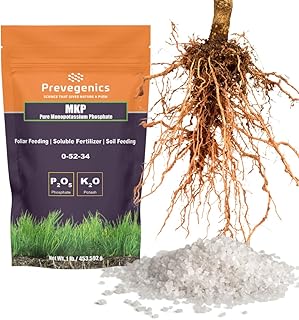
Best for: Gardeners who want a fertilizer described as 0-52-34 and prefer the option of applying it dry or dissolving it in water. The listing identifies phosphorus and potassium as water-soluble and says the product transports water and nutrients.
Compared with the vegetable-planting fertilizer above, this option provides a stated fertilizer analysis in its name and makes dry or dissolved application explicit. It may suit buyers who already know which application method fits their gardening routine.
Limitation: The listed features do not provide specific mixing rates or crop directions. Do not infer a dose from the product name; consult the package instructions for application guidance.
Potassium Phosphate Monobasic, 500 Grams

Best for: Buyers seeking a 500-gram container of potassium phosphate monobasic powder. The listing describes a white, slightly granular powder in a plastic bottle and states a minimum purity of 99%.
This is a better fit for someone comparing general chemical specifications and quantity than for a gardener who needs crop-specific instructions. Its listed indefinite shelf life may be relevant to buyers who do not expect to use the product quickly, provided it is stored appropriately.
Limitation: The provided information does not identify it as fertilizer, food grade, or reagent grade. Verify the intended-use grade before using it for a particular application.
Laboratories Potassium Phosphate Fine Crystals

Best for: Buyers specifically looking for potassium phosphate monobasic listed as reagent grade. Product details state 99+% purity and an 8-ounce, or 227-gram, quantity. The fine-crystal form and grade make these specifications the key reasons to compare it with general-purpose powders.
Choose this if the stated reagent grade and smaller package match your requirements. It is not interchangeable with a fertilizer simply because both contain potassium phosphate; intended use and grade matter.
Limitation: The provided features do not describe fertilizer directions or food-grade status. Avoid choosing it for either use unless the product labeling confirms suitability.
CCS Food-Grade Monopotassium Phosphate

Best for: Buyers seeking a product explicitly listed as food grade. The listing also identifies it as kosher and halal certified, gives a 1-kilogram quantity, and provides CAS number 7778-77-0.
Compared with the reagent-grade crystals, this product is the clearer option when the required specification is food grade. Confirm that its documentation and labeling meet the needs of your intended use; the listed grade alone does not explain application amounts.
Limitation: The supplied features do not include fertilizer analysis or gardening application directions. Choose a product marketed for plants if your purpose is garden feeding.
Buying Guide
Which grade should you choose?
Start with the intended use. For plant feeding, compare products sold as fertilizer and follow their labels. For laboratory needs, check the stated reagent grade and purity. For food-related use, look for an explicit food-grade designation and verify the product documentation. A chemical name by itself does not establish that a product is appropriate for every use.
Do nutrient analysis and application instructions matter?
Yes. A stated analysis, such as 0-52-34, helps fertilizer buyers compare nutrient composition. Application directions are still essential because the product name does not tell you how much to apply or how to prepare a solution. Do not substitute instructions from one product for another.
How should you compare package size and form?
Compare the listed quantity with how much you expect to use and whether the product is described as powder or fine crystals. The 500-gram and 227-gram options provide stated quantities, while the food-grade listing gives a 1-kilogram size. Check the product details for storage and handling directions.
Frequently Asked Questions
Is potassium dihydrogen orthophosphate the same as MKP?
Potassium dihydrogen orthophosphate is commonly referred to as monopotassium phosphate or MKP. Product labels may use different versions of these names, so confirm the listed grade and intended use.
Can potassium dihydrogen phosphate be used as fertilizer?
Some products are sold as fertilizer and provide phosphorus and potassium. Use only according to the specific product’s label and application directions.
Can I use reagent-grade material for food?
Do not assume so. Reagent grade and food grade are different product specifications. Choose a product explicitly labeled for the intended use.
What does 0-52-34 mean on an MKP fertilizer?
It is the fertilizer analysis stated in the product name. Check the package label for its explanation and directions before applying it.
Does water-soluble mean the product has a universal mixing rate?
No. Water solubility does not establish an appropriate dose. Follow the instructions for the exact product and intended application.