A soil moisture meter can help peace lily owners check moisture near the roots instead of relying only on the soil surface. The XLUX standard meter is a straightforward pick for everyday pots, while its long-probe version suits deeper containers. Hathdia’s adjustable-head meter is useful when the dial is hard to view, and Censinda offers a simple battery-free option. The XLUX two-pack can help gardeners check more than one plant. Use readings as a guide alongside your plant’s condition and care routine.
| Meter | Best suited for | Standout feature |
|---|---|---|
| XLUX Soil Moisture Meter | Everyday peace lily pots | Large, color-coded dial |
| XLUX Long Probe Meter | Deep or large pots | Probe is 5.5 inches longer than regular styles |
| Hathdia Adjustable-Head Meter | Low or hard-to-reach plants | Four reading-head angles |
| Censinda Soil Moisture Meter | Simple battery-free checks | Dry, moist, and wet indication |
| XLUX Orange 2 Pack | Checking multiple plants | Two meters in the set |
XLUX Soil Moisture Meter
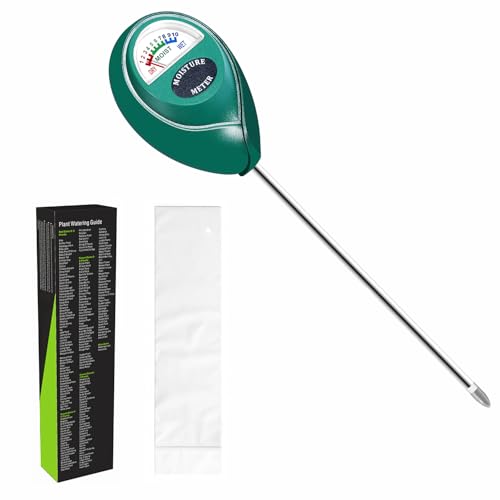
Best for: Peace lily owners who want a simple, reusable meter for typical indoor pots. The XLUX has a high-sensitivity probe intended to measure moisture deeper in the soil than a surface check can reveal. Its large dial has three zones—dry, moist, and wet—with ten scales for a more detailed reading.
The meter works without batteries or charging, and its reading appears immediately after insertion. Those features make it a practical choice for routine checks when the soil surface does not tell the whole story. It was selected as the best general-purpose option because the dial is designed to be easy to interpret.
Limitation: This model reports soil moisture; it does not measure other growing conditions such as light or pH.
XLUX Long Probe Moisture Meter

Best for: Peace lilies planted in deeper or larger containers. This XLUX model has a probe 5.5 inches longer than regular styles, which can reach lower into a pot to check moisture near the bottom. Its large dial uses three zones and ten scales, and the reading is immediate after insertion.
Choose this version if a standard probe may not reach the area you want to check. It is battery-free, so there is no charging step before use. The longer reach is the main reason it stands out for deep pots, where the surface may dry sooner than soil lower in the container.
Limitation: The manufacturer says not to leave the meter in soil for more than five minutes because the metal tip can gradually corrode.
Hathdia Adjustable-Head Moisture Meter
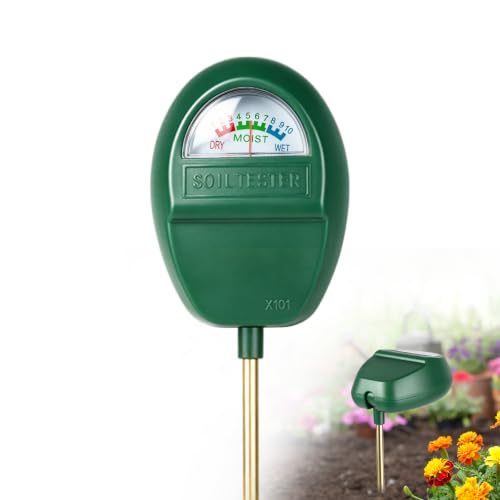
Best for: Checking plants positioned low, high, or in places where a fixed dial is awkward to read. Its head adjusts to 0°, 30°, 60°, or 90°, allowing the display angle to be changed. The seven-inch probe reaches into deeper soil, and the color-coded dial responds immediately without batteries.
This meter was selected for viewing flexibility as well as probe length. Choose it if reading a fixed-head meter would require bending or repositioning the pot. The probe is intended to reach root-zone soil in large pots, raised beds, or garden soil.
Limitation: The supplied product details do not specify a corrosion warning or additional measurement functions, so treat it as a moisture-only tool.
Censinda Battery-Free Moisture Meter
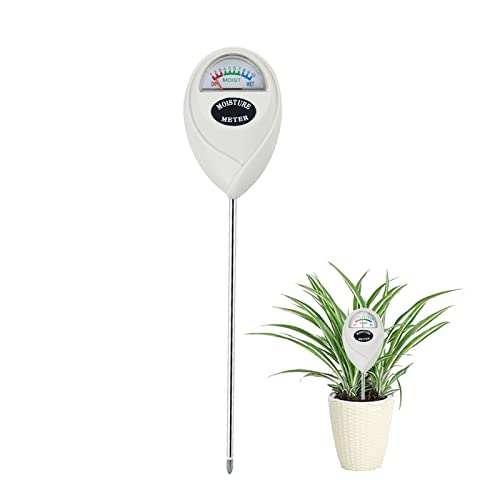
Best for: Buyers who want a basic way to distinguish dry, moist, and wet soil. Censinda says to insert the probe near the plant’s root area and read the meter without waiting. It needs no battery or electricity, making it a simple option for occasional peace lily checks.
This model was selected for its direct, uncomplicated moisture-checking approach. It can help reduce guesswork when the top layer looks dry but the soil deeper in the pot may still be moist. Use the reading to inform a watering decision rather than treating the meter as a substitute for observing the plant.
Limitation: The listed features do not describe a long probe or a multi-angle dial, so it may be less suitable when reach or viewing position is the main concern.
XLUX Orange Two-Pack Moisture Meters

Best for: Plant owners who want a meter available for more than one pot. Each meter detects deep soil moisture and displays dry, moist, or wet zones on a large dial with ten scales. The reading appears immediately after the probe is inserted.
The two-meter set was selected for multi-plant routines. You can keep one near a peace lily and use the other for another pot or garden check. Like the XLUX single meter, this set does not need batteries.
Limitation: The manufacturer advises removing the meter within five minutes because the metal tip can gradually corrode.
Buying Guide: Choosing A Peace Lily Moisture Meter
How long should the probe be?
Match probe reach to the depth of the pot. A regular probe may suit a typical container, while a longer probe can help check soil farther down in a deep pot. Insert the probe carefully near the root area and avoid forcing it through resistance.
Is a battery-free meter enough?
For moisture checks alone, a battery-free analog meter can keep operation simple. The listed Censinda and XLUX options show readings on a dial without batteries. A digital multi-function meter may be worth considering if you also want measurements such as soil pH, temperature, or light, but those functions are not included in the five moisture-only picks above.
How should you use the reading?
Check more than one spot if moisture may vary across the pot. Remove the probe after reading, and follow any care instructions supplied with the meter. A meter reports soil moisture at the probe location; it does not independently determine the ideal watering schedule for every peace lily or potting mix.
Frequently Asked Questions
Can a moisture meter help me avoid overwatering a peace lily?
Yes. It can show whether soil at the probe depth is dry, moist, or wet, giving you more information than the surface alone. Use the reading as one input in your watering decision.
Where should I insert the meter?
Insert the probe into the soil near the plant’s root area. For a deep pot, choose a probe long enough to reach the depth you want to check.
Do these meters need batteries?
The Censinda and XLUX analog meters described here are battery-free. The XLUX two-pack is also listed as requiring no batteries.
Can I leave a moisture meter in the pot?
Do not leave the XLUX long-probe or XLUX two-pack meter in soil for more than five minutes; the product information warns that the metal tip can corrode. Remove meters after taking a reading.
Does a moisture meter measure sunlight?
These five selected products are described as soil moisture meters. Their listed features do not include sunlight measurement.