The best mouse trap depends on whether you want a quick-kill snap trap, a reusable option, or a catch-and-release design. Victor’s 12-pack is best for covering several rooms with traditional snap traps; USKICH offers reusable plastic snap traps; and the blinc trap is designed for live capture. For adhesive options, Tomcat is a compact choice, while Catchmaster Max-Catch provides a larger 36-trap supply.
| Product | Best For | Trap Type |
|---|---|---|
| Victor Metal Pedal | Multiple rooms | Wooden snap |
| USKICH Reusable Traps | Reusable setup | Plastic snap |
| blinc Humane Trap | Live capture | Catch and release |
| Tomcat Glue Traps | Compact placement | Adhesive |
| Catchmaster Max-Catch | Bulk indoor coverage | Adhesive |
Victor Metal Pedal Wooden Snap Traps

Victor’s 12-pack includes reusable wooden snap traps with a metal trigger pedal. The manufacturer describes the trigger as designed to activate when a mouse interacts with it, and the traps are intended for indoor use. Having 12 traps in one set can make this a practical choice when activity is suspected in several rooms or along multiple pathways.
Best for: Households looking for a traditional snap-trap approach and enough units to distribute around the home. Choose this if you want a multi-trap set rather than a single reusable device. Limitation: These traps kill mice, so they are not suitable for buyers who want live capture. Keep snap traps away from children and pets.
USKICH Reusable Plastic Snap Traps

This six-pack uses reusable ABS plastic traps with a double-spring mechanism and a tail clip with a nail hole intended to help secure placement. The product features describe a non-contact baiting design and recommend using a small amount of peanut butter. The plastic construction can be cleaned and reused, unlike disposable adhesive boards.
Best for: Buyers who want reusable snap traps and prefer a design that can be baited without placing fingers near the trigger. The compact form may suit flexible placement around suspected mouse pathways. Limitation: This is still a kill trap, not a humane live-capture option. The suggested bait is not included in the listed features.
blinc Humane Catch-And-Release Trap
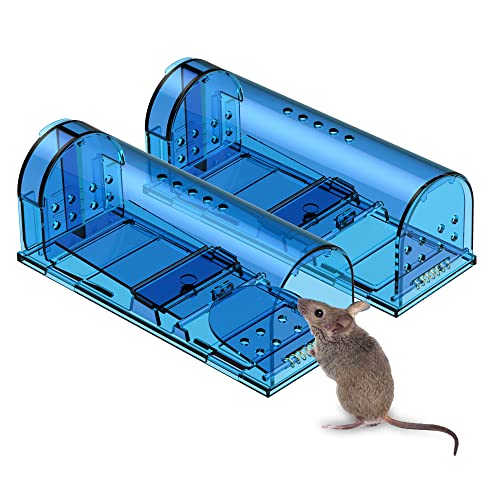
The blinc two-pack is designed to capture mice alive for release rather than use glue, poison, or a snapping spring. Its listed features include ventilation holes and a sliding back door intended to let users release the mouse without handling it closely. This makes it distinct from the other picks, which are designed to trap or kill pests.
Best for: People seeking a reusable catch-and-release trap for indoor or outdoor placement. Choose this if avoiding a kill mechanism is your main priority. Limitation: A live-capture trap requires monitoring so a captured mouse is not left inside for an extended period. The product’s humane and pet-safety descriptions are manufacturer claims; placement should still be chosen carefully.
Tomcat Mouse-Size Glue Traps

Tomcat’s six mouse-size glue traps use a professional-strength adhesive with eugenol, according to the product description. They are intended to catch mice as well as household pests such as cockroaches, spiders, and scorpions. Suggested placement includes along walls or in cupboards where activity is suspected, including kitchens, basements, and garages.
Best for: Buyers who want ready-to-place adhesive traps in compact locations. The listed ability to capture insects as well as mice may appeal to people addressing more than one household pest. Limitation: These traps are not mouse-specific in what they can catch, so avoid placing them where non-target animals may reach them. Adhesive traps also do not offer live release.
Catchmaster Max-Catch 36 Glue Traps

Catchmaster Max-Catch is a 36-pack of pesticide-free adhesive traps intended for indoor use. The product description says the traps can catch mice, rats, insects, and other pests, and recommends placing them along known or suspected pathways. They are designed for use without added bait; leaving the paper on initially is suggested to help pests acclimate.
Best for: Buyers who want a larger supply of disposable traps for several indoor locations. Choose this over the smaller Tomcat pack if quantity is the deciding factor. Limitation: These sticky boards can capture insects and other pests as well as mice, and they do not provide catch-and-release handling. The stated year-long lifespan applies to normal indoor conditions.
Buying Guide: How To Choose A Mouse Trap
Do you want a quick-kill or live-capture trap?
Snap traps are designed to kill mice and include traditional wood-and-metal and reusable plastic styles. A live-capture trap is the relevant choice if you want to release the mouse rather than kill it. Glue traps are adhesive capture devices, not catch-and-release traps.
Where will you place the traps?
Look for signs of activity and place traps along suspected pathways, such as near walls or in cupboards, following the product directions. A multi-pack can help cover several locations. Keep traps out of reach of children and pets, especially when they have a spring mechanism or exposed adhesive.
Should you choose reusable or disposable traps?
Reusable plastic snap traps can be cleaned and reset, while wooden snap traps may also be reused according to their design. Glue boards are generally disposable after capture or when they are no longer effective. Consider whether you prefer resetting a trap or replacing it.
Is bait required?
The listed Victor and USKICH snap-trap features do not specify an included bait. USKICH recommends a small amount of peanut butter. The Catchmaster glue traps are described as ready to use without added bait; Tomcat’s listed features focus on its adhesive and placement.
Frequently Asked Questions
What type of mouse trap is best for a home?
It depends on your priority. Choose a snap trap for a kill mechanism, a live-capture trap for release, or an adhesive trap if you want a glue-board design.
Where should mouse traps be placed?
Place them near suspected mouse pathways, such as along walls or in cupboards, and follow the specific product instructions.
Are glue traps reusable?
The listed Tomcat and Catchmaster glue products are disposable adhesive traps. Their features do not describe them as reusable.
Which option is designed to release a mouse alive?
The blinc trap is specifically described as a reusable catch-and-release device with a sliding release door.
Do glue traps require bait?
The Catchmaster Max-Catch features state that no additional bait is required. Check the directions for any trap before setting it.