Answering the need for reliable curved turnouts, these HO scale options are suited for hobbyists building compact yards, rounded curves, or scenic sections. This guide highlights five top choices, explaining who benefits most from each and why they were selected. Whether you’re assembling a small switching yard or expanding a loop, these curved turnouts offer smoother track transitions and better geometry for longer rolling stock.
| Product | Best For |
|---|---|
| PECO SL-87 HO C100 Insulfrog Dbl Curved Left-Hand Turnout | Ultra-smooth insulfrog design; ideal for reliable switch points in modest curves |
| PECO SL-86 HO C100 Insulfrog Dbl Curved Right-Hand Turnout | Symmetrical performance for right-hand curves in compact layouts |
| Atlas Curved Left Turnout Code 100 | Clean geometry for classic Code 100 track with curved alignment |
| Walthers Mainline 948-83062 HO Scale Code 83 Nickel Silver DCC-Friendly Curved Turnout | Better for DCC layouts needing nickel silver rail and curved radii |
| PECO SL-E86 HO C100 Electrofrog Dbl Curved Right-Hand Turnout | Electrofrog switch with reliable electrical continuity in curved routes |
PECO SL-87 HO C100 Insulfrog Dbl Curved Left-Hand Turnout

Product overview: PECO SL-87 is a double curved left-hand turnout in HO scale with a C100 rail code and insulfrog electrical isolation. This model emphasizes precision engineering and straightforward installation. It is well suited for hobbyists prioritizing dependable mechanical performance and easy wiring for DCC or DC layouts.
Best for: Operators who need a left-hand curve in tight spaces, especially in yards or branch lines where smooth deployment of locomotives and rolling stock matters. The insulfrog design reduces the risk of electrical shorting in simplified DC layouts and is compatible with many standard HO curves.
Why chosen: The SL-87 integrates PECO’s reputation for consistent geometry and reliable throw. The double curved setup accommodates more natural transitions through bends, minimizing derailments on installations with limited straight sections.
Limitation: Insulfrog tracks may require attention to electrical isolation in complex DCC scenarios; some operators prefer electrofrog for guaranteed power continuity in every point. Ensure compatibility with your controller and turnout throw style.
PECO SL-86 HO C100 Insulfrog Dbl Curved Right-Hand Turnout

Product overview: This right-hand version mirrors the SL-87’s insulfrog design, offering a double curved turnout in HO scale with C100 rails. The emphasis is on precise alignment and user-friendly installation, making it a strong choice for curved interchange or yard tracks.
Best for: Layouts that mirror left-hand curves with symmetrical needs, or environments where right-hand curves are more practical due to space constraints or surrounding scenery.
Why chosen: The SL-86 provides consistent performance, helping prevent derailments at the transition point and enabling smoother entry/exit from curved sections.
Limitation: Like other insulfrog models, wiring considerations are important for complex layouts. Verify that your control system and adjacent track plan minimize potential shorting
Atlas Curved Left Turnout Code 100
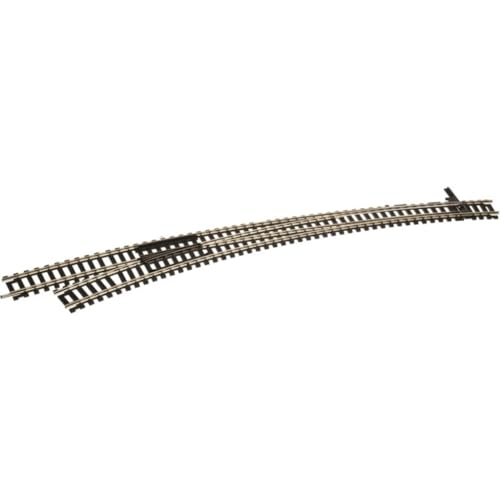
Product overview: Atlas Curved Left Turnout Code 100 is designed to join curved sections with Code 100 rails. It focuses on creating a clean geometric transition with reliable alignment for HO-scale trains. The part is compatible with standard Atlas track systems and offers a smooth path through the turnout.
Best for: Modelers who prefer the classic Atlas Code 100 rail profile and want a curved left-hand turnout for yards, branch lines, or loop expansions without leaving gaps in the curve.
Why chosen: The curved geometry reduces sharp transitions, contributing to reliability when running longer locomotives around bends. It is a solid choice for traditional layouts seeking a consistent look and fit.
Limitation: Limited to Code 100 rail; if your layout uses different rail heights or code, compatibility adjustments may be necessary. Check coupling and track alignment with adjacent pieces.
Walthers Mainline 948-83062 Curved Turnout, Code 83

Product overview: This Walthers Mainline turnout uses Code 83 nickel silver rails and is DCC-friendly, with curved radii suitable for flowing track plans. The focus is on detailed presentation for realism and ease of wiring in DCC systems, complemented by compatibility with typical HO-scale scenery and structures.
Best for: DCC-enabled layouts that benefit from nickel silver rails and flexible curved radii. It suits layouts aiming for a more refined appearance and smoother electrical performance along curved sections.
Why chosen: The Code 83 profile offers a balance between strength and appearance for hobbyists who want a visually convincing curved transition without sacrificing reliability in power delivery.
Limitation: Nickel silver rails can require more careful maintenance to prevent oxidation and ensure consistent electrical contact over time. Plan for regular checks during layout operation.
PECO SL-E86 HO C100 Electrofrog Dbl Curved Right-Hand Turnout

Product overview: The SL-E86 Electrofrog curved turnout uses an electrofrog configuration, delivering continuous electrical connectivity through the switch points. It is a double curved, right-hand turnout designed for HO scale with C100 rails and specific radius details.
Best for: Operators who require improved electrical reliability across the turnout, particularly in layouts with multiple power feeds or longer trains that demand consistent power through the switch area.
Why chosen: Electrofrog designs provide a strong advantage in power continuity. The curved double radius helps maintain smooth wheel passage through the turnout without intermittently lifting wheels at the points.
Caution: Electrofrog turnouts can be more sensitive to wiring mistakes; ensure correct polarity and connections to prevent short circuits on DC or DCC systems.
Buying Guide: Curved Turnouts for HO Scale Layouts
What to consider when choosing curved turnouts
- Code and rail type: Code 83 offers a realistic rail profile; Code 100 is compatible with many older or broader track systems. Choose to match your existing track.
- Frog type: Insulfrog reduces electrical contact at the frog, simplifying DC layouts, while Electrofrog maintains power continuity through the switch points, beneficial for DCC layouts.
- Radius and curvature: Double-curved turnouts help minimize abrupt transitions. Check the available radii and ensure they fit your overall track plan and space constraints.
- Electrical considerations: For DC, insulfrog can be simpler; for DCC, electrofrog or nickel-silver rails may offer improved performance. Plan wiring early.
- Installation and compatibility: Verify alignment with your existing track, turnout throws, and roadbed. Ensure the turnout slope and tie spacing match your layout to avoid gaps.
Questions to guide your selection
- Is your layout primarily DC or DCC, and does the turnout type align with that choice?
- Do you have space for standard radii, or do you need tighter curves that require double-curved turnouts?
- Which rail code best matches the rest of your system for visual continuity?
- Are you prioritizing electrical reliability through the turnout, or is ease of installation your main goal?
- Do you need left-hand or right-hand curves to fit your specific track plan?
Frequently Asked Questions
- What does “insulfrog” mean for HO turnouts? It isolates the normal flow of electricity at the switch points to reduce short circuits on DC layouts.
- What is “electrofrog” used for in curved turnouts? It provides continuous electrical contact through the frog, which helps with reliable operation on DC and DCC layouts.
- Are curved turnouts compatible with standard HO track? Yes, but confirm the code (rail size) and radius so that wheel flanges and rail joints align correctly.
- What are common radii for curved HO turnouts? Typical curved turnouts use radii that fit 20″ to 24″ layouts, with some models offering tighter or larger options depending on the brand.
- How should I maintain curved turnouts? Regularly clean track surfaces, inspect for alignment, and check electrical connections to prevent derailing or power loss.
- Which brand offers the most realistic curved turnouts? Brand choice depends on your preference for code, frog type, and radius; PECO and Walthers are popular for consistent geometry and realistic appearance.
Note: This article presents selections based on available product features and typical uses for HO-scale curved turnouts. Always verify compatibility with your existing track plan before purchasing.