The best hair growth and thickness oil depends on whether you want a rich rosemary blend, a compact scalp treatment, or a formula aimed at sensitive skin. VITAL AFFAIR is best for shoppers seeking a multi-oil blend; Botanic Hearth and ArtNaturals are rosemary-and-castor options; Mielle suits dry-scalp care and varied hair textures; and CNLAWKUO offers a roll-on serum format. These products are intended to support scalp care and fuller-looking hair, but the listed product information does not establish that any oil can treat medical hair loss.
| Product | Best For | Notable Features |
|---|---|---|
| VITAL AFFAIR Rosemary Blend | Multi-oil conditioning | Rosemary, castor, batana, biotin, and vitamin E |
| Botanic Hearth Rosemary Oil | Rosemary-focused routine | Rosemary, biotin, jojoba, and castor oils |
| Mielle Rosemary Mint Oil | Dry scalp and multiple hair textures | Biotin, mint, and several essential and carrier oils |
| CNLAWKUO Roll-On Serum | Targeted, portable application | Roll-on format, panthenol, and botanical extracts |
| ArtNaturals Rosemary and Castor Set | Simple two-oil blend | Rosemary and castor oils for scalp and hair conditioning |
VITAL AFFAIR Rosemary Castor Blend

This 6-fluid-ounce blend combines rosemary with castor, batana, grapeseed, and jojoba oils, plus biotin and vitamin E. Its listed features emphasize scalp moisture, strand conditioning, and reducing breakage. The formula is positioned for people who want one product with several oils rather than a single-ingredient treatment.
Best for: Shoppers looking for a rich, multi-oil option to support a scalp and hair-care routine. It was selected for its broad ingredient blend and specific focus on dryness, breakage, and scalp comfort. Limitation: The product information does not provide application frequency or evidence that it regrows hair; check the label and patch-test before use, especially if sensitive to botanical oils.
Botanic Hearth Rosemary Hair Oil
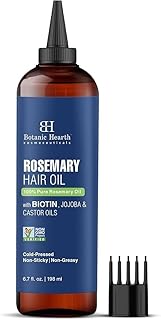
Botanic Hearth’s 6.7-fluid-ounce oil pairs rosemary with biotin, jojoba oil, and castor oil. The listed features describe a conditioning scalp formula intended to help strengthen strands and reduce breakage, while also soothing dryness associated with dandruff. Its larger stated bottle size may appeal to people who want a rosemary oil for regular hair-care use.
Best for: Buyers who want rosemary as the central ingredient with complementary oils. Choose this if your priority is scalp conditioning and stronger-looking strands in a rosemary-focused blend. Limitation: The product description does not specify how much of each ingredient is included or establish results for hair growth. People with a reactive scalp should review the full ingredient label before applying.
Mielle Rosemary Mint Hair Oil

Mielle’s 2-ounce oil blends biotin and mint with rosemary, castor, tea tree, jojoba, coconut, and peppermint oils. The brand describes it as a scalp and hair treatment for dryness and flaking, with conditioning support from root to tip. It is listed as suitable for all hair types and textures, making it a versatile option for households with different hair-care needs.
Best for: People seeking a compact oil for dry-scalp care and strand conditioning across hair textures. It stands out for its combination of oils and clearly stated scalp-care focus. Limitation: The formula includes mint, peppermint, and tea tree oils, which may not suit every sensitive scalp. Start cautiously and discontinue if irritation occurs.
CNLAWKUO Hair Growth Roll-On Serum

This 30-milliliter product uses a roll-on applicator and lists biotin, caffeine, saw palmetto, rosemary leaf extract, fermented rice water, and panthenol. Chamomile extract and other botanical ingredients are described as supporting a gentler scalp-care experience. The formula also aims to condition dry or frizzy-looking strands and maintain scalp moisture.
Best for: Buyers who prefer targeted application over pouring oil onto the scalp, or who want a compact serum format. Its listed calming ingredients make it a possible option for people looking for a sensitive-scalp-oriented formula. Limitation: The listed features do not include the full ingredient concentrations or confirm suitability for every sensitive scalp. Follow package directions and patch-test first.
ArtNaturals Rosemary And Castor Oil

ArtNaturals combines rosemary and castor oil in a 4-ounce set intended for women and men. Its listed features focus on nourishing the scalp, moisturizing hair, and helping strands feel soft and manageable. Compared with blends that list many additional oils or extracts, this option keeps its featured ingredient pairing straightforward.
Best for: Shoppers who want a rosemary-and-castor combination for scalp and hair conditioning without a long list of highlighted ingredients. It was selected as a simple alternative to more complex blends. Limitation: The supplied product details do not identify other ingredients or explain the set contents, so check the package listing for complete formula and use instructions.
Buying Guide: How To Choose A Hair Oil
Which ingredients and format fit your routine?
Start with the purpose of the product. Rosemary-based oils are common in this selection, while castor, jojoba, grapeseed, and coconut oils are included in some formulas for conditioning. Biotin appears in several products, but its presence alone does not prove that a topical oil will cause new hair growth. A roll-on may make targeted application easier; a standard oil blend may be more suitable if you also want to condition hair lengths.
How should you compare scalp comfort and hair texture?
Check the complete ingredient list if you have a sensitive scalp or known allergies. Essential oils such as peppermint and tea tree can be irritating for some people. Consider how much product you want to apply and whether a heavier-feeling blend suits your hair. The supplied details do not compare residue, scent strength, or performance across hair types, so those factors cannot be ranked reliably here.
What should you expect from a hair growth oil?
These products describe support for scalp moisture, reduced breakage, and fuller-looking hair. Those cosmetic goals are different from treating the cause of persistent shedding or hair loss. Apply products only as directed, avoid contact with eyes, and stop use if irritation develops. For sudden, patchy, or ongoing hair loss, consult a qualified health professional rather than relying on an oil alone.
Frequently Asked Questions
Can hair oil make hair grow faster?
The listed product features describe support for scalp care, conditioning, or reduced breakage. They do not establish that these oils speed hair growth or treat the cause of hair loss.
Which option is best for dry scalp?
Mielle and Botanic Hearth explicitly describe scalp conditioning and relief from dryness or flaking. Review their ingredients and patch-test if your scalp is sensitive.
Is a roll-on serum easier to apply?
A roll-on is designed for targeted application and may suit people who prefer not to pour oil directly onto the scalp. Follow the package instructions for use.
Should I patch-test a hair oil?
Yes. Apply a small amount according to product directions and watch for irritation before using it more broadly, especially if you have sensitive skin.
When should I seek medical advice for hair loss?
Seek professional advice for sudden, patchy, persistent, or concerning hair loss. A cosmetic oil may condition hair but should not replace evaluation of an underlying cause.