If you’re cutting foam insulation, styrofoam, or insulating boards, you need a tool designed for clean edges, steady heat, and safe operation. This guide highlights five top foam insulation cutting tools, chosen for different project needs—from DIY crafts to professional insulation retrofit work. Each product is best for a specific type of user: hobbyists, professional installers, or mechanical contractors. Use the quick comparison below to identify which tool fits your work style, then read detailed sections to understand why it’s a fit and where to avoid drawbacks.
| Product | Best For | Key Benefit |
|---|---|---|
| Cooltop Hot Wire Foam Cutter Kit | DIY hobbyists and small projects | Fast heat-up and versatile tips |
| GDGJWL Pipe Insulation Cutting Guide | Professional plumbing and large-scale insulation | Multi-size accuracy with durable fixtures |
| DOMINOX Hot Knife Foam Cutter | Broad material range | Spring-loaded safety and smooth cuts |
| YKPIW Insulation Knife With Scale | Precise measurements on-site | Laser scale with dual-edge blade |
| Preciva Hot Knife With Digital Display | Studio/craft environments demanding control | Digital temperature readout and 20 settings |
Cooltop Hot Wire Foam Cutter Kit

The Cooltop kit provides a 3-in-1 foam cutting pen with hot wire, holeing, and engraving tips. It heats to about 100°C within 10 seconds, enabling smooth cuts in foam boards, blocks, and related materials. It includes a cleaning pen to maintain tip performance and features an ON/OFF switch with an LED indicator for safe operation. Best for hobbyists or DIY installers who value speed, simple maintenance, and versatility in one compact tool. Caution: prolonged use at high heat without breaks can cause tip wear; allow cooling periods as recommended.
GDGJWL 6PCS Insulation Cutting Guide Kit

This set includes six ABS-molded cutting fixtures in multiple diameters (15MM, 22MM, 28MM, 40MM, 46MM, 53MM) plus a long 59″ tape measure. It’s designed for precise, 360° foam tube cuts with durable, CNC-machined fixtures that resist impact better than some 3D-printed options. Best for professional plumbing or industrial insulation work where consistent, repeatable cuts are critical. Limitation: heavier kits may require more storage space and careful handling in tight spaces.
DOMINOX Hot Knife Foam Cutter Kit

The DOMINOX kit uses a spring-loaded safety trigger to reduce burn risk, with a variety of tips and blades for foam, KT board, and other materials. The copper induction coil supports fast, even heating for smooth, edge-clean cuts. Best for professionals who need a robust kit that can handle high-frequency use and diverse materials. Choose this if you need multiple blade options and a safety-first design. Caution: use in short intervals (about 15 seconds on, 15 seconds off) to extend tool life.
YKPIW Insulation Knife With Scale

The YKPIW model combines measuring scale and a double-sided, serrated stainless steel blade. Permanently laser-etched SAE markings allow on-site measuring and marking while cutting foam, rockwool, drywall, and more. Best for installers who need to measure and cut in one pass to minimize waste. Limitation: wood or metal blades may not perform as well on very dense foams without slowing or dulling the edge over time.
Preciva Hot Knife Foam Cutter With Digital Display
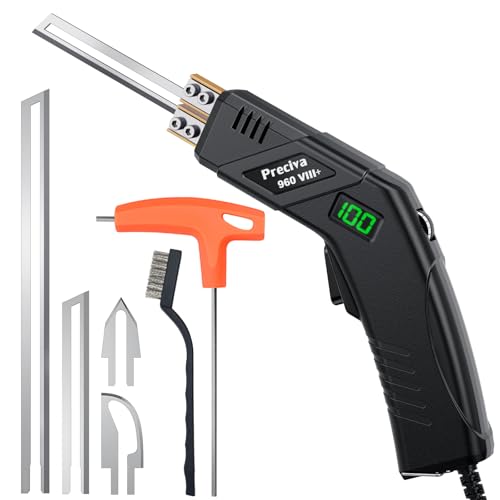
Preciva’s hot knife features a digital display and 20 adjustable temperatures, ranging from 200°C to 600°C. It runs on 80W, 110V-127V, and includes overheat protection. The display shows a reference value rather than exact Fahrenheit/Celsius, so users should convert for precise temps. Best for studios or craft environments where precise heat control matters and users want to tailor cuts to different foam densities. Caution: temperature readings require a quick conversion to interpret correctly.
RONGTER 4 in 1 Hot Wire Cutter Kit

The RONGTER kit provides four blades (U, F, 2″ straight, 4″ straight) plus replacement hot wires and a case. It’s designed for fast, clean cuts and can reach high temperatures on the U and F tips, enabling efficient work on various foam shapes. Best for professional users who need multiple cutting profiles and a portable storage solution. Caution: ensure proper use with the included safety features to avoid edge scorching or tip damage during extended sessions.
Buying Guide
- Material compatibility: Choose a cutter that supports the foam types you encounter (PE, XPS, EPS, KT board, etc.).
- Heat control: For delicate foams, prefer tools with quick heat-up and stable temperatures to avoid melting or tearing edges.
- Tip versatility: A unit with multiple tips or blades expands applications from precise engraving to deep cuts in thicker boards.
- Safety features: Look for overheat protection, spring-loaded triggers, and stable rests or stands to prevent burns and accidents.
- Maintenance: Tools with easy tip replacement and cleaning accessories help maintain clean cuts and longer tool life.
- Portability: For field work, consider weight, case inclusion, and compact design that fits in a tool belt.
Frequently Asked Questions
- What is the best foam cutter for beginners? Answer: A lightweight, 3-in-1 cutter like the Cooltop kit offers versatile tips, quick heating, and a safety design suitable for beginners.
- Which cutter is best for scaling up insulation projects? Answer: The GDGJWL Insulation Cutting Guide Kit provides multiple diameters and a tape measure for precise, repeatable cuts in professional settings.
- Do hot knife cutters require cool-down periods? Answer: Yes. Several models recommend short off periods (e.g., 15 seconds on, 15 seconds off) to extend needle life and prevent overheating.
- Can I use a foam cutter for drywall or rockwool? Answer: Some models are designed for multiple materials; verify the blade type and material compatibility before use on tougher insulation.
- Is a digital display necessary for foam cutting? Answer: Not essential, but a display helps manage temperatures in craft studios and ensures consistent results across sessions.
- What maintenance helps extend cutter life? Answer: Regular tip cleaning, replacing worn wires, and wiping copper tips after use reduce buildup and maintain edge quality.