The best fixed asset labels depend on where they will be applied and how your team identifies equipment. AMWOOMA is a fit for buyers seeking preprinted, sequential barcode labels; Avery suits organizations that want to print labels on demand; and XpressTags offers durable vinyl and metalized polyester options. Bunny Badges is a choice for custom logo and barcode labels. Compare label size, material, adhesive, and numbering before selecting tags for your inventory process.
| Product | Best for | Key feature |
|---|---|---|
| AMWOOMA 2 x 1-inch labels | Preprinted barcode identification | Waterproof metalized polyester |
| XpressTags 1 x 2-inch vinyl | Sequential numbering on varied surfaces | Permanent acrylic adhesive |
| Avery Metallic Asset Tags | In-house, on-demand printing | Laser printable, 240 labels |
| XpressTags 0.75 x 1.5-inch polyester | Compact equipment labels | Brushed metalized polyester |
| Bunny Badges Custom Asset Tags | Logo-branded barcode labels | Custom prefix and sequential Code 128 barcodes |
AMWOOMA 2 x 1-Inch Barcode Asset Tags

These preprinted labels are designed for organizations that want sequential identification without setting up a print workflow. The pack uses 2 x 1-inch silver metalized polyester labels, numbered from 1 to 100. The listed material is waterproof, scratch-resistant, and UV fade-resistant, making this option relevant for everyday asset tracking in offices, warehouses, schools, and stores.
AMWOOMA is best for buyers who need standard-size barcode labels for equipment and supplies. The listing describes high-contrast barcode printing intended for scanning with mainstream scanners and mobile devices. Choose this if the provided sequence and label size suit your inventory plan. A limitation is that the listed sequence runs from 1 to 100, so it may not fit buyers who need a different numbering range or custom identifiers.
XpressTags 1 x 2-Inch Sequential Vinyl Labels

This XpressTags option uses 1 x 2-inch vinyl labels with sequential numbering and permanent acrylic adhesive. The product information describes the vinyl as durable and conformable for a range of applications, with adhesive intended to stick to irregular surfaces. Its smooth surface can be wiped clean of dirt, grease, and water.
It is best for buyers who want numbered inventory stickers and need a permanent adhesive for equipment with less-than-flat surfaces. Pack sizes are listed from 100 to 5,000, giving buyers quantity options. Choose this if vinyl and a 1 x 2-inch label fit the asset. The listing does not specify that these labels include barcodes, so buyers who require scannable codes should verify the label format before ordering.
Avery Metallic Laser-Printable Asset Tags
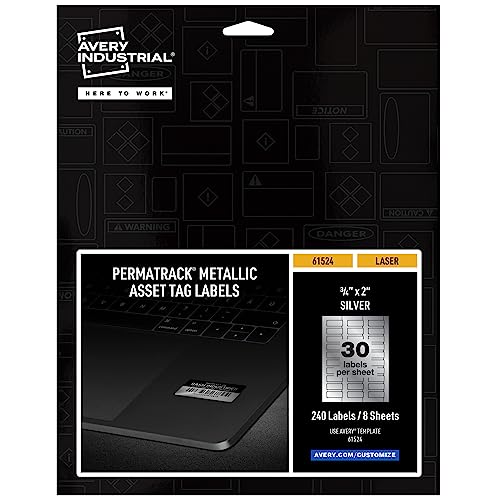
Avery’s metallic asset labels measure 3/4 x 2 inches and come as 240 waterproof labels. They are designed for laser printing, and the product information highlights an industrial-grade permanent adhesive. Avery Design & Print software includes templates and a barcode generator, allowing users to create and print labels as needed.
This product is best for teams that want to control label content and print additional tags on demand. It can avoid ordering a large quantity of custom-printed labels when asset records change. The listed material is also described as chemical-resistant and abrasion-resistant. Choose this if your organization has access to a compatible laser printer and prefers in-house label creation. Avoid assuming it works with an inkjet printer; the listing specifies laser printing.
XpressTags Compact Metalized Polyester Tags

These 0.75 x 1.5-inch fixed inventory labels use brushed metalized silver polyester and include a barcode and serial number, according to the product name. The listing describes a 2-mil high-tack adhesive intended to hold on irregular surfaces, including equipment, machinery, and electronics. Dirt, grease, and water can be wiped from the smooth surface, and the tags are specified for areas with light chemical splash.
This is best for buyers who need a smaller label with a metallic appearance and sequential asset information. Choose this if a compact format is more suitable than a 1 x 2-inch tag. The smaller size leaves less room for printed details, so check that the label’s information remains readable for your inventory process. The listing describes light chemical splash use; do not treat that as a claim of resistance to heavy chemical exposure.
Bunny Badges Custom Logo Barcode Labels

Bunny Badges offers 2 x 0.7-inch labels that can include an uploaded logo and an organization name. Buyers enter a prefix and starting number, and the seller creates sequential Code 128 barcodes. The product listing describes the labels as laminated and waterproof for indoor and outdoor use, with pack sizes from 50 to 5,000.
This option is best for organizations that want branded labels with a defined numbering scheme. It can help make asset identification consistent across departments or locations. Choose this if your team needs custom branding and sequential barcode data rather than generic numbered stickers. Because the layout is customized, prepare the logo, organization name, prefix, and starting number before placing an order. The listed label dimensions are relatively narrow, so account for available space on the asset.
Buying Guide: How To Choose Fixed Asset Labels
Should you choose preprinted or printable labels?
Preprinted sequential labels are useful when you want a ready-made numbering series. Custom labels can include a logo, prefix, or barcode format, but require accurate setup information. Printable tags are better when staff need to create labels as assets are added or records change. Check the printer type specified by the product before choosing an in-house printing option.
Which label size and material fit the asset?
Measure the flat or usable area on the equipment before selecting a tag. A 2 x 1-inch label offers more room than a 0.75 x 1.5-inch option, while a narrower label may suit compact devices. Polyester and vinyl are different material choices; compare the listing’s stated resistance and surface-care details with the conditions where the asset is used.
What should you check about adhesive and scanning?
For irregular surfaces, look for a product that specifically describes adhesive performance on those surfaces. For barcode tracking, confirm the label includes a barcode, and choose a format that works with your scanning process. A printed number alone is not necessarily a barcode. Keep the chosen sequence and identifier format consistent with your asset records.
Frequently Asked Questions
What information belongs on a fixed asset label?
Common identifiers include an asset number or barcode. Some organizations also use a company name, logo, or prefix, depending on their tracking system and available label space.
Are all asset tags waterproof?
No. Waterproofing is product-specific. Check the material and durability claims for the exact label you plan to use.
Can I use a phone to scan asset barcodes?
Some listed barcode labels are described as readable by mobile scanning devices or cellphones. Confirm the barcode type and scanning workflow for the specific product.
When are custom asset labels useful?
Custom labels are useful when an organization needs its logo, a chosen prefix, or a particular starting number alongside sequential barcode identification.