Answering the need for reliable, hands-free feeding, these fish tank food dispensers automate meals for your aquarium. They are ideal for busy owners, travelers, and households with multiple tanks. Top picks range from compact vacation feeders for small Betta bowls to larger, moisture-proof systems for ponds and community tanks. The list below highlights five models that balance accuracy, ease of use, and versatility across common aquarium setups.
Summary of Selected Products
| Product | Best For | Key Benefit | Tank Type |
|---|---|---|---|
| FISHNOSH Automatic Fish Feeder (ML) | Small to large tanks, ponds | Programmable up to 3 feedings per day with a clear reset process | Freshwater/Saltwater |
| DXOPHIEX Automatic Fish Feeder | Multiple power options, adjustable timing | Battery + USB power, flexible mounting | Most tanks with hood or open edge |
| Aoyar Automatic Fish Feeder | Travelers and holidays | 200ml capacity, moisture-proof lid, three interval modes | Small to medium tanks |
| Petbank Automatic Fish Feeder | Moisture-prone environments | 16 compartments for precise meals, moisture-sealed | Most tanks |
| Papettly Automatic Fish Feeder | Precise feeding with rings | Four feeding modes, moisture-proof lid, feeding ring for accuracy | Freshwater/Aquariums |
FISHNOSH Automatic Fish Feeder (ML) Review

Best for mid-to-large tanks and ponds requiring reliable daily feed cycles. The ML model supports automatic feeding with timers and easy refill without dismantling. It is suitable for owners who travel and want predictable nutrition schedules. The product emphasizes a simple setup and a user-friendly refill process, making it accessible for households with children who assist in care. A potential limitation is that some users may want additional port sizes for bigger pellets.
DXOPHIEX Automatic Fish Feeder

Best for tanks that need flexible power options and extended unattended operation. This feeder supports automatic cycles every 8, 12, or 24 hours and offers battery as well as USB power, with a back-up capability during outages. It can be mounted on tank edges or hoods, which helps fit diverse aquarium designs. A limitation is the reliance on correct alignment for consistent dispensing, especially on edge-mounted setups.
Aoyar Automatic Fish Feeder

Best for travelers seeking a simple but feature-rich device with a large capacity. The Aoyar feeder provides three fixed feeding modes (8/12/24 hours) and a 200ml hopper for longer trips. Its moisture-proof design helps keep food dry during humid conditions. Choose this if you want a straightforward device with reliable interval feeding; avoid if you need more than three daily feedings or if you require advanced app-style scheduling.
FISHNOSH Automatic Fish Feeder (ML) Model-ML

Best for users who want a familiar feeding pattern with a modern design and a reset-friendly workflow. The ML variant emphasizes automatic scheduling with up to three feedings per day and a convenient refill without disassembly. It is suitable for small tanks, large tanks, and ponds alike. A potential caveat is the need to align the device for maximum dispensing accuracy when used in larger, deeper tanks.
Papettly Automatic Fish Feeder

Best for aquariums that benefit from a feeding ring to concentrate food and maintain clean water. Papettly offers four feeding modes, a moisture-proof lid, and a feeding ring to minimize food dispersion. It suits hobbyists who want reliable, scheduled feedings without messy leftovers. Note that the ring adds an extra setup step and may require trial to balance portion sizes for very small or very large fish.
Freesea Automatic Fish Feeder
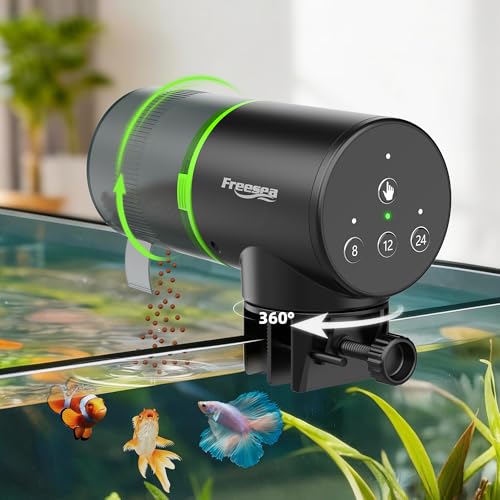
Best for 3-timer setups with extended vacation coverage. Freesea emphasizes a 7-14 day capacity with three timers and a moisture-proof lid that helps prevent clumping. It is suitable for Betta, goldfish, and small community tanks. A limitation is that very large fish or heavy feeding needs may require closer monitoring to avoid underfeeding on long trips.
PetbankAutomatic Fish Feeder

Best for precision and moisture control in varying environments. Petbank features 16 feeding grids, two installation options, and a fully sealed moisture-proof design that minimizes humidity impact. It accommodates a range of foods, including pellets and powders, but not suitable for shrimp or flakes. This makes it a strong choice for mixed-tish tank setups that prioritize controlled portions.
Buying Guide: How to Choose the Right Fish Tank Food Dispenser
- Feeding schedule needs: Do you require up to 3 feedings per day or more frequent intervals? Models with multiple modes provide greater flexibility.
- Tank size and placement: Consider edge-mounted versus hood-mounted dispensers. Larger tanks may benefit from devices with wider hoppers and more stable mounting.
- Power source: Batteries, USB, or dual power options offer resilience during outages. USB-powered units often provide longer-term convenience.
- Moisture control: Moisture-proof lids reduce clumping, especially in high-humidity environments or with pellets.
- Food type compatibility: Check if the feeder supports pellets, flakes, powders, or specialty foods. Some units are not suitable for shrimp or flakes.
- Portion control: Devices with adjustable portions help prevent overfeeding and water quality issues. Look for clear, precise grids or sliders.
- Ease of cleaning and refilling: Refill without disassembly and simple cleaning routines save time and reduce spill risk.
Frequently Asked Questions
- How many feeds per day should a fish tank feeder provide?
Most devices support 2-3 feeds per day, with some offering additional cycles or manual feeding. - Can these feeders work with both pellets and flakes?
Many models accommodate pellets and some powders, but not all support flakes. Check food compatibility before buying. - Do feeders require batteries or can they run on USB power?
Several models offer battery and USB power options or dual power supply partnering for outage resilience. - Is a feeding ring necessary?
Feeding rings help concentrate food and keep tanks cleaner, but they are optional depending on the model and fish behavior. - What maintenance is required?
Regular refilling, occasional cleaning of the hopper and dispensing mechanism, and checking seals for moisture are recommended.