For EMF and RF shielding projects, choose conductive fabric based on the area you need to cover, the signals you want to block, and how you plan to join the material. Mission Darkness is best for buyers prioritizing documented shielding tests; Galtunmy suits smaller DIY projects and includes conductive tape; and ZTTXL’s three-yard option provides more fabric for larger builds. The products below include different materials, dimensions, and supporting details, so compare the listed specifications before choosing.
| Product | Best For | Listed Size |
|---|---|---|
| Mission Darkness TitanRF | Buyers seeking test documentation | 1 yard, 44″ × 36″ |
| Galtunmy Faraday Fabric | Small projects and included tape | 43″ × 36″ |
| Erthree RF Shielding Fabric | Small inserts and liners | Size not stated in features |
| Amerthing Pure Copper Fabric | Copper-only material and tape | 78″ × 43″ |
| ZTTXL Faraday Fabric | Projects needing three yards | 43″ × 118″ |
Mission Darkness TitanRF Faraday Fabric

This one-yard kit measures 44 by 36 inches and includes 36 inches of tape. The fabric composition is listed as polyester fiber, metallic copper, and metallic nickel. The product information says shielding effectiveness was tested to MIL-STD-188-125 and IEEE 299-2006, with full reports available upon request.
Best for: Buyers who want a compact piece with stated test standards and a tape accessory. Listed signal coverage includes Wi-Fi, Bluetooth, cellular signals including 5G, GPS, RFID, and radio signals from low MHz to 40 GHz. It is also described for RF enclosures, bags, and signal isolation projects.
Limitation: One yard is a modest amount for large curtains or room-scale coverage. The listing advises wearing gloves if sensitive to the materials.
Galtunmy Faraday Fabric With Tape
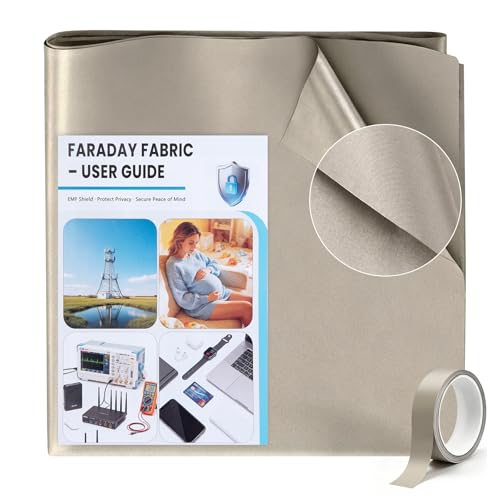
The listed compact size is 43 by 36 inches, and the product name specifies conductive tape. Galtunmy describes its material as copper-nickel fabric and states 70–80 dB shielding, along with blocking claims for RFID, EMF, and RF signals. The listing also describes a larger 43-by-118-inch size; confirm the selected option before ordering.
Best for: DIY beginners making wallet liners, card sleeves, key-fob pouches, or small device covers. The compact dimensions are easier to plan around than a long fabric roll, and the included tape may be useful when constructing an enclosure.
Limitation: The supplied details do not specify a test report or frequency range. Verify the exact size and shielding information for the option you select.
Erthree RF Shielding Fabric

Erthree describes this conductive fabric as copper and cloth, with a scratch-proof, durable construction. Its listed uses include inserting it into a wallet or handbag to help protect cards from data theft. The product features also name cell, Bluetooth, Wi-Fi, and GPS signals.
Best for: Buyers considering a small liner or insert rather than a large enclosure. The stated use and signal categories make it relevant for personal accessories and card protection projects.
Limitation: The provided product details do not state fabric dimensions, a frequency range, or test results. Check the current listing for the amount of material and any project-specific specifications before planning a cut.
Amerthing Pure Copper Faraday Fabric

This copper fabric measures 78 by 43 inches, or about two meters by 1.08 meters, and has a listed thickness of 0.085 mm. The package includes a piece of pure copper tape. The listing gives surface resistance below 0.03 ohm and describes the material as a conductive grid for a Faraday-cage concept.
Best for: Buyers who specifically want copper fabric and a stated surface-resistance figure. Its longer dimension offers more coverage than the compact one-yard options for some DIY layouts.
Limitation: The provided features do not name specific blocked wireless bands or provide a shielding-effectiveness test report. Its copper construction also differs from copper-nickel and copper-nickel-polyester fabrics.
ZTTXL Faraday Fabric, Three Yards

This option measures 43 inches wide by 118 inches long, approximately three yards. ZTTXL lists metallic copper and metallic nickel as materials and describes possible uses including curtains, blankets, bags, phone cases, computer covers, and card holders.
Best for: Buyers who need a longer continuous piece for several smaller projects or a larger DIY cover. It provides substantially more length than the one-yard options in this comparison.
Limitation: The listing instructs users not to wash or rub the fabric, to avoid staining it, and to let it air-dry in a cool place if a small area gets wet. Gloves are recommended during handling.
Buying Guide: How To Choose EMF Blocking Fabric
How much fabric should you buy?
Measure the finished project before ordering and allow extra material for seams, folds, overlaps, and closures. A 36-inch piece may suit an accessory, while a 118-inch length is more practical for multiple projects or a larger cover. Check both width and length; “yard” alone does not establish the usable dimensions.
Which material and performance details matter?
Compare the stated fiber composition, frequency coverage, shielding figures, and test documentation. Copper-only fabric and copper-nickel blends are not identical. If a project requires blocking particular signals, look for those signals or frequencies in the product details rather than relying only on broad labels such as “Faraday” or “EMF shielding.”
Do seams and handling affect a DIY build?
Plan how edges will overlap and close, since gaps can undermine an enclosure’s continuity. Tape is included with some options, but the listings do not establish that every tape or seam method works for every project. Follow the manufacturer’s care instructions; some fabric listings caution against washing or abrasive handling.
Frequently Asked Questions
What is EMF blocking fabric used for?
Conductive shielding fabric is used in DIY projects such as device covers, bags, liners, curtains, and enclosures intended to reduce or block selected radio-frequency signals. Results depend on the material, construction, and how completely the project is closed.
Does all Faraday fabric block every wireless signal?
No. Signal coverage varies by product and construction. Check the stated frequency range or named signal types, and seek test documentation when performance requirements are important.
Can I sew Faraday fabric into a bag?
The listed products describe uses such as bags, wallets, and device covers. Plan for continuous coverage at seams and openings, and follow the product’s handling instructions.
Is copper fabric the same as copper-nickel fabric?
No. The products in this comparison list different compositions. Compare the material details and any available performance data instead of assuming the fabrics are interchangeable.
How do I choose between one yard and three yards?
Choose based on measured project dimensions and the extra material needed for seams or multiple items. A shorter cut can suit a small accessory; a longer roll offers more material for larger or repeated projects.