The right DWV-to-Schedule 40 adapter depends on pipe size and connection style: a reducing coupling joins different pipe diameters, a reducing bushing fits inside a larger adapter, and a trap adapter connects a drain tailpiece to a slip fitting. The products below are PVC fittings described for drainage or Schedule 40 use. The two 4-inch-by-2-inch couplings are best for reducing between those pipe sizes; the bushing suits a specific 3-inch adapter connection, and the trap adapter is for a 1-1/2-inch drain connection.
| Product | Connection style | Best suited for |
|---|---|---|
| Fitvell 4-inch x 2-inch reducer | Socket x socket | Joining 4-inch and 2-inch PVC pipe |
| Lswteiz 4-inch x 2-inch reducer | Socket x socket | A 4-inch-to-2-inch reducing connection |
| Lswteiz 3-inch x 1-1/2-inch bushing | Socket x socket | Reducing a compatible 3-inch adapter opening |
| PlumberStop 1-1/2-inch trap adapter | Socket x slip | Connecting a trap to a PVC DWV fitting |
Fitvell 4-Inch X 2-Inch PVC Reducer

This Schedule 40 slip reducing coupling connects 4-inch and 2-inch PVC pipe using socket connections at both ends. The listed fit is for 4-inch pipe with a 4.5-inch outside diameter and 2-inch pipe with a 2.374-inch outside diameter. Its smooth interior is intended to limit friction and material buildup.
Best for: A direct pipe-to-pipe size transition from 4 inches to 2 inches. It is a straightforward option when both pipes match the listed dimensions and a socket coupling is appropriate. The product information describes PVC as resistant to frost and corrosion.
Limitation: This is a 4-inch-by-2-inch reducer, not a universal adapter. Installation uses primer and solvent cement, so it is not a detachable connection.
Lswteiz 4-Inch X 2-Inch Reducer Coupling
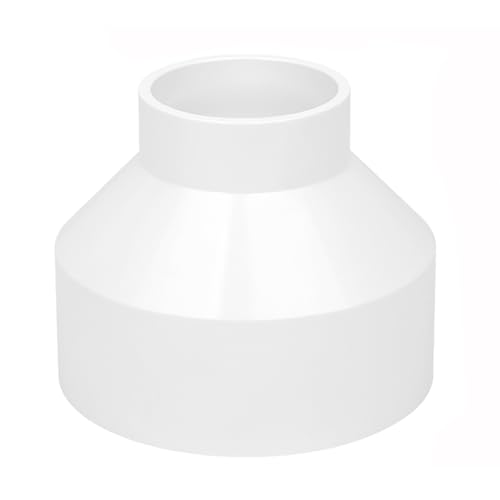
This socket-by-socket Schedule 40 PVC fitting is listed for connecting 4-inch and 2-inch pipe. The manufacturer describes it as a reducer for pipes of different diameters and notes a smooth interior finish. The specified pipe dimensions are 4-inch ID/4.50-inch OD and 2-inch ID/2.374-inch OD.
Best for: Buyers seeking the same nominal size transition as the Fitvell coupling, with product information that specifically describes a reducing design for high-flow systems. Choose it when the listed pipe dimensions and socket connection match the installation.
Limitation: The listing calls for primer and solvent cement. Confirm local plumbing requirements and fitting dimensions before installation; this is not a threaded or removable coupling.
Lswteiz 3-Inch X 1-1/2-Inch Reducing Bushing

This Schedule 40 PVC reducing bushing connects to 1-1/2-inch PVC pipe on one end. Its larger end is designed to fit a 3-inch PVC adapter, not directly into 3-inch pipe. That distinction makes it different from a reducing coupling, which connects pipe ends at both sockets.
Best for: A connection where a compatible 3-inch adapter is already part of the setup and a 1-1/2-inch outlet is needed. The listing specifies socket-by-socket installation with primer and solvent cement and says the fitting is intended for systems not exceeding 140°F.
Limitation: Do not select it as a direct 3-inch-pipe-to-1-1/2-inch-pipe coupling. The larger end requires a 3-inch adapter.
PlumberStop 1-1/2-Inch DWV Trap Adapter

This fitting is designed for Schedule 40 PVC drain, waste, and vent systems. It has a socket-by-slip connection and includes a plastic nut and washer. Unlike the reducer fittings above, it is intended to connect a trap or slip-style drain connection to a solvent-weld socket fitting.
Best for: A 1-1/2-inch DWV connection where a trap adapter is needed rather than a pipe-size reducer. The product description highlights residential, commercial, and industrial drainage applications and an installation that requires no special tools.
Limitation: It does not reduce pipe diameter. Check that the trap connection and fitting arrangement match the adapter’s socket and slip ends.
Buying Guide: How To Choose A DWV Adapter
What connection are you making?
Start by identifying whether you need to join two pipe ends, insert a smaller fitting into a larger adapter, or connect a trap. A reducing coupling is typically for pipe-to-pipe transitions. A reducing bushing fits into a compatible larger fitting. A trap adapter serves a drain-trap connection. These styles are not interchangeable.
Do the nominal size and actual dimensions match?
Check both nominal pipe size and the fitting’s stated connection dimensions. The 4-inch-by-2-inch couplings list specific pipe outside diameters. The 3-inch-by-1-1/2-inch bushing has a specific warning: its larger end connects to a 3-inch adapter, not directly to 3-inch pipe.
Is the connection solvent-weld or slip-style?
Socket fittings commonly use primer and solvent cement, as the two reducing couplings and bushing specify. A slip connection, such as the one described for the trap adapter, uses a different connection arrangement. Follow the fitting instructions and applicable local plumbing code.
Is Schedule 40 suitable for the project?
Confirm that the fitting’s material, intended DWV use, temperature limits, and connection type meet the requirements of the drainage system. These products are described as PVC fittings, but the listings do not establish suitability for every plumbing application or local code.
Frequently Asked Questions
Are DWV and Schedule 40 fittings the same thing?
Not necessarily. DWV describes a drain, waste, and vent application, while Schedule 40 describes a pipe or fitting specification. Check the specific fitting’s stated use, dimensions, and compatibility rather than relying on the terms alone.
Can a reducing bushing connect directly to pipe?
It depends on its design. The listed Lswteiz 3-inch-by-1-1/2-inch bushing specifically requires a 3-inch adapter at its larger end, so it is not described as a direct connection to 3-inch pipe.
Which listed product reduces 4-inch pipe to 2-inch pipe?
The Fitvell and Lswteiz reducing couplings are both listed for 4-inch-to-2-inch PVC connections with socket ends.
Does a trap adapter reduce pipe size?
No. The PlumberStop fitting is described as a 1-1/2-inch DWV trap adapter for a socket-to-slip connection, not as a reducing fitting.
Do these fittings require solvent cement?
The two 4-inch-by-2-inch reducers and the reducing bushing specify primer and solvent cement. Follow the product instructions for the selected fitting.