Answering the need for reliable, tool-free connections between copper and CPVC (or related) piping, these fittings are designed for quick, secure transitions in residential plumbing. The top picks below are best for DIY projects, remodeling, or professional work where a fast, watertight seal matters. Ideal buyers include homeowners upgrading pipe systems, plumbers seeking efficient push-to-connect options, and installers working with mixed pipe materials.
Summary table of selected products:
| Product | Best For | Key Benefit |
|---|---|---|
| SharkBite 3/4 Inch CTS x 3/4 Inch PVC Transition Coupling | PVC-to-Copper/CPVC transitions | Push-to-connect, no tools, identifies ends by color |
| SharkBite Max 1/2 Inch Coupling | Copper/CPVC to PEX or SDR-9 HDPE transitions | Reinforced collar for strength, low insertion effort |
| SharkBite 1/2 Inch CTS x 1/2 Inch PVC Transition Coupling | PVC-to-CPVC/PEX/Copper | Clear collar indicators, easy wet-line install |
| SharkBite Max 3/4 Inch MNPT Adapter | CTS to FNPT transitions | Strong, durable, fast installation in wet lines |
| (Pack of 10) EFIELD 1/2 Inch Straight Coupling | Copper, PEX, CPVC, PE-RT piping | Bulk value with standard straight coupling |
SharkBite 3/4 Inch CTS x 3/4 Inch PVC Transition Coupling
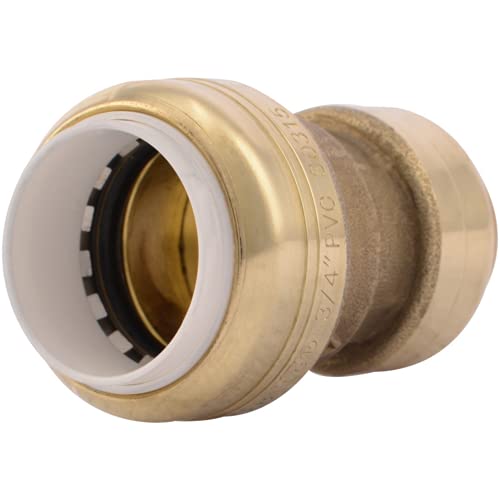
This push-to-connect brass fitting combines a white collar for PVC with a tan collar for PEX, CPVC, and copper. It is designed to transition from any PVC pipe to another pipe type without glue or soldering. It can be installed in wet lines, saving time on messy jobs. Best for projects that switch from PVC to metal or CPVC while maintaining a reliable seal.
- Best for PVC-to-Copper/CPVC transitions in retrofit or new installs.
- Better for quick connections where tools are limited or avoided.
- Caution: The transition relies on a proper push-to-connect seal; ensure no debris in the pipe ends.
SharkBite Max 1/2 Inch Coupling

This coupling features a reinforced stainless steel collar and is designed for fast, tool-free connections between copper, CPVC, PEX, and SDR-9 HDPE pipes. Its low insertion force helps when tight spaces are a factor. Best for tight spaces or when you need a durable, single-size coupling with minimal effort.
- Best for easy, wet-line installations with multiple pipe types.
- Better for projects requiring strong, long-lasting joints.
- Caution: Some installations may require careful alignment to avoid leak-prone misfits.
SharkBite 1/2 Inch CTS x 1/2 Inch PVC Transition Coupling

This transition fitting uses color-coded collars to identify each end: white for PVC and tan for PEX, CPVC, PE-RT, SDR-9 HDPE, or copper. It enables watertight connections without glue or soldering and is suitable for wet-line installations. Best for small-diameter transitions where PVC meets another material.
- Best for PVC-to-CPVC or CPVC-to-Copper transitions in tight runs.
- Better for quick, glue-free changes during plumbing updates.
- Caution: Verify collar seating to prevent leaks at the joint.
SharkBite Max 3/4 Inch MNPT Adapter

This adapter provides a push-to-connect path from CTS pipe to FNPT threads, enabling quick transitions to threaded fittings or valves. It is compatible with copper, CPVC, PEX, PE-RT, and SDR-9 HDPE pipes, and is designed for use in wet lines. Best for converting to threaded fixtures without soldering or gluing.
- Best for CTS-to-FNPT transition needs in compact layouts.
- Better for installations where threading is required downstream.
- Caution: Ensure proper thread engagement and sealing when connecting to male fittings.
SharkBite Max 3/4 x 3/4 Inch FNPT Adapter

Push-to-connect master adapter for transitioning between same-size pipes to FNPT threads. Suitable for PEX, copper, CPVC, PE-RT, and SDR-9 HDPE pipe types. It supports wet-line installation and benefits from the robust SharkBite collar design for durable performance. Best for standard 3/4 inch pipe projects with threaded endpoints.
- Best for standard 3/4 inch transitions to threaded components.
- Better for uniform pipe runs with consistent sizing.
- Caution: Confirm thread type and sealant requirements before final assembly.
Buying Guide: Copper To CPVC Fittings – Key Considerations
- Material compatibility: Ensure the fitting supports copper, CPVC, PEX, SDR-9 HDPE, and PE-RT as needed for your project.
- Connection type: Push-to-connect fittings provide tool-free installation but verify pipe cleanliness and straight insertion for best results.
- End configurations: Transition couplings, adapters, and MNPT/FNPT adapters cover most common needs; plan for the downstream components.
- Space and access: In cramped spaces, low-insertion-force designs reduce effort and improve reliability.
- Maintenance and replacements: Consider color-coded collars and clear indicators to minimize mix-ups during installs.
- Wet-line viability: Many options are rated for wet-line installation; verify compatibility with your water system and local codes.
FAQ
- What is the main advantage of push-to-connect fittings for copper and CPVC?
- Are these fittings suitable for outdoor use?
- Can I mix copper, CPVC, and PEX with these fittings?
- Do these fittings affect water pressure or flow?
- Is a disconnect tool ever required?
- What should I check if a leak appears after installation?
They provide tool-free, quick installations with a watertight seal, often usable in wet lines without soldering or gluing.
Many are designed for indoor use; check product specifications for temperature ranges and exposure to elements before outdoor installation.
Yes, most options are designed to connect copper, CPVC, PEX, PE-RT, and HDPE where indicated by color collars and listed compatibility.
Fittings themselves are not typically a primary limiter; avoid shoving pipes into joints and ensure smooth pipe ends to minimize flow restrictions.
Some products include a disconnect option for removing a joint, which can be handy during maintenance or future updates.
Inspect collar seating, ensure pipes are clean and fully inserted, and re-seat the joint if necessary following the manufacturer’s guidance.