Choosing the right clear flexible PVC tubing depends on what you’ll transfer, the environment, and the required durability. This guide highlights five top Amazon options that balance clarity, flexibility, and resistance to chemicals. The best picks are suited for hobbyist setups, home labs, beverage dispensing, aquarium plumbing, and general low-pressure piping. Each product section explains who it’s best for, plus practical limits to consider. A quick comparison table at the end of the introduction helps you see key differences at a glance.
Product Snapshot
| Product | Best For | Key Benefit |
|---|---|---|
| Eastman 1/2″ ID Clear PVC Tubing, 10 ft | Low-pressure transfer, potable water | Clear, versatile for many liquids |
| Eastrans 1/4″ ID Clear Vinyl Tubing, 10 ft | Compact, light-duty piping | Flexible and chemical resistant |
| Eastrans 1/2″ ID Clear Vinyl Tubing, 5 ft | Short runs, tight spaces | Balanced size and flexibility |
| Eastrans 1/2″ ID 25 ft Clear Vinyl Tubing | Longer runs, cost efficiency | Long length with consistent wall |
| DERNORD 3/8″ ID x 1/2″ OD, 10 ft | General industrial liquids | Food-grade suitability |
Eastman 1/2 Inch ID Clear PVC Tubing, 10 Ft

Size and material: 1/2 inch ID (5/8 inch OD), 10 feet. This Eastman tubing is a clear PVC vinyl option suitable for low-pressure transfer. It supports a wide range of liquids, chemicals, and gases, making it versatile for drainage lines, potable water, beverages, aquariums, and lab use. Best for buyers needing a general-purpose, transparent tube that resists kinking and offers easy visual inspection. Limitations: not recommended for ice maker supply applications.
Who it’s best for: DIY homeowners and hobbyists who need flexible, transparent tubing for simple fluid transfers, aquarium setups, or lab projects. Why selected: it combines clear visibility with practical flexibility and broad compatibility with common low-pressure tasks.
Eastrans 10ft x 1/4″ ID Clear Vinyl Tubing

Material and dimensions: PVC, 1/4″ ID, 3/8″ OD, 10 feet, with a wall thickness of 1.55 mm. Hardness around 73A indicates firm but flexible tubing. Temperature range from -5°C to 65°C (23°F to 149°F) and a working pressure near 60 PSI. This makes it suitable for lightweight, everyday transfers and applications where a small-diameter tube is required. Caution: suitability for highly aggressive chemicals is not stated; typically best for common household liquids and mild chemicals.
Who it’s best for: Small-scale projects or devices requiring compact tubing with straightforward installation. Why selected: its small ID fits precise fittings and allows easy routing in tight spaces. Better for: low-volume systems and hobby projects. Avoid this if: you need high-pressure or high-temperature performance.
Eastrans Clear Vinyl Tubing, 1/2″ ID, 25 Feet
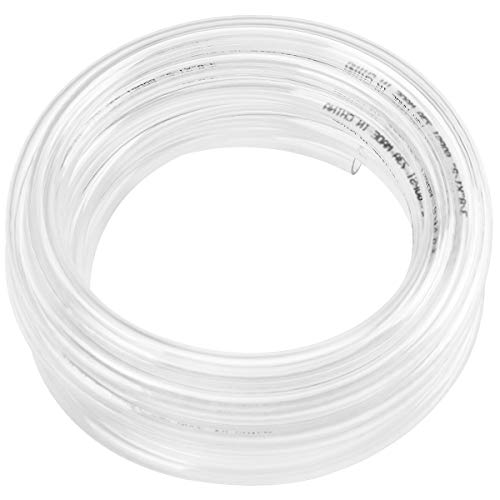
Details: 1/2″ ID, 5/8″ OD, 25 feet, with a 1.6 mm wall and 73A hardness. Temperature tolerance mirrors other Eastrans entries, 23°F to 149°F, and a 60 PSI working pressure. Benefits include smooth interior and exterior surfaces to minimize sediment buildup and facilitate flushing. This makes it a practical option for longer runs in non-corrosive environments. Limitation: long runs can still kink if not properly supported.
Who it’s best for: users needing a longer coil for moderate-length runs without complexity. Why selected: competitive length and consistent wall thickness support reliable flow and cleaning between uses. Choose this if: you want a cost-effective, mid-length solution that’s easy to cut and fit. Avoid this if: you anticipate higher-pressure demands.
DERNORD PVC Tubing 3/8″ ID x 1/2″ OD, 10 Ft

Size and usage: 3/8″ ID by 1/2″ OD, 10 feet. Designed for general industrial liquid conveyance and compatibility with most barbed fittings and connectors. High-level benefit includes smooth interior and exterior surfaces that facilitate easy flow and cleaning. Best for buyers needing a food-grade or general-purpose clear tube for non-abrasive liquids. Limitation: product details do not specify exact food-grade certification, so verify if required for specific food processes.
Who it’s best for: shop owners or makers needing a versatile tube for everyday liquid transfers in non-critical settings. Why selected: balanced dimensions and broad fitment potential. Choose this if: you value a simple, reliable tube without specialized features. Avoid this if: you require explicit food-grade assurances.
Eastman 3/8 Inch ID Clear PVC Tubing, 10 Ft

Size and usage: 3/8″ ID (1/2″ OD), 10 feet. This Eastman tubing handles a broad set of liquids, chemicals, and gases, ideal for low-pressure transfer and flow control. It’s multipurpose for drainage, potable water, beverage dispensers, aquariums, and labs. Best for buyers who need visibility along the tubing length to monitor flow. Not recommended for ice maker supply. Caution: ensure compatibility with the specific chemical or liquid being transferred.
1/2″ ID x 3/4″ OD High-Pressure Braided Clear PVC Tubing

Specifications: 1/2″ ID, 3/4″ OD, 10 ft. Heavy-duty braided clear PVC tube designed for high-pressure use. Features a thick wall (3.2 mm) and 200 PSI working pressure, with 23°F to 149°F temperature range. It resists UV light and chemicals, reducing the risk of cracking or weakening under sunlight exposure. Best for: systems where rigidity and higher pressure tolerance are needed. Limitation: braided construction may feel stiffer than unbraided tubing, making some routing difficult in very tight spaces.
Buying Guide: What To Consider When Shopping For Clear PVC Tubing
- Size and fit: Choose ID and OD to match your fittings and the flow rate you need. Smaller IDs reduce flow, while larger IDs increase it. Wall thickness affects durability and flexibility.
- Temperature and pressure: Check the tubing’s temperature range and working pressure. Low-temperature environments require materials that stay flexible in the cold; high-pressure applications require thicker walls or braided designs.
- Chemical compatibility: Ensure the PVC tubing is compatible with the liquids or gases you are transferring. Some products are better suited for water and mild chemicals; others tolerate harsher substances.
- Clarity and cleaning: Clear tubing allows visual inspection of flow and sediment. Smooth interiors help with flushing and easier cleaning, especially for lab or beverage uses.
- Flexibility vs. stiffness: Flexible tubing is easier to route in tight spaces, while stiffer braided tubing may withstand higher pressures and resist kinking.
- Food-grade and safety: If transferring consumables, verify food-grade status or suitability for potable water and laboratory use.
FAQ
- What is the main advantage of clear PVC tubing? – It allows you to visually monitor flow, identify blockages, and verify clear pathways in complex setups.
- Can I use clear PVC tubing for hot liquids? – Check the temperature range on the product; many options tolerate up to 149°F, but higher temperatures require heat-resistant alternatives.
- Is braided tubing always stronger than non-braided? – Generally, braided tubing offers higher pressure tolerance, but may be less flexible in tight spaces.
- Is these tubes suitable for potable water? – Some items are designed for potable water and lab use; always confirm explicit safety and certifications for drinking water.
- How do I cut PVC tubing cleanly? – Use a sharp utility knife or tubing cutter and ensure a straight, square cut for a proper seal with fittings.
- What should I avoid with clear PVC tubing? – Avoid exposing tubes to ice-maker supplies or aggressive chemicals unless the product specifically states compatibility.