Clear, reliable carbon copy notebooks help you duplicate notes for lab records, memos, and reporting. This guide highlights top options suited for students, researchers, and professionals who need quick, accurate copies. Each pick is evaluated for copy quality, binding, page layout, and durability. The table below summarizes the five selected products to compare at a glance.
| Product | Brand | Pages / Sets | |
|---|---|---|---|
| BARBAKAM Lab Notebook | BARBAKAM | 100 carbonless pages | Researchers needing simple, reliable carbonless pages |
| Affrolling 1 Pack Carbonless Lab Notebook | Affrolling | 50 pages + 25 carbon sheets, 1 set | Students and technicians who want color-differentiated copies |
| Yeplan Carbonless Lab Notebook | Yeplan | 50 sets | Professionals needing sturdy, grid-based lab notes |
| BookFactory Carbonless Lab Notebook | BookFactory | 50 carbonless sets | U.S.-made option with durable Wire-O binding |
| Affrolling 2 Pack Carbonless Lab Notebook | Affrolling | 100 pages total (50 sets) | Bulk or shared lab environments needing more copies |
The following sections detail each product, with clear guidance on who benefits most, along with practical caveats to help you choose confidently.
BARBAKAM Lab Notebook 100 Carbonless Pages

Features: carbonless paper (self-copying pages) for quick duplication of notes. The notebook is suitable for basic lab record-keeping and field notes where a simple carbonless option is sufficient. Best for solo researchers or students who want a straightforward two-part record without separate carbon sheets.
Best for: individuals who need a compact, easy-to-use carbon copy notebook with dependable paper that transfers handwriting clearly.
Limitations: lacks additional features like grid pages or built-in data tables, which may be needed for more complex experiments.
Affrolling 1 Pack Carbonless Lab Notebook

Features: 8.5 x 11 inches with 25 white pages and 25 yellow carbon paper sheets, plus a clear acrylic sheet. Color partitioning (white vs yellow) helps visually separate originals from copies. Coil binding enables 360° flipping and rounded corners reduce snagging. Clear copy utility for chemistry work and data sharing.
Best for: students and lab technicians who value immediate, color-differentiated copies and a sturdy coil-bound format.
Caution: the set is single-pack; larger projects may require multiple notebooks for extended experiments.
Yeplan Carbonless Lab Notebook
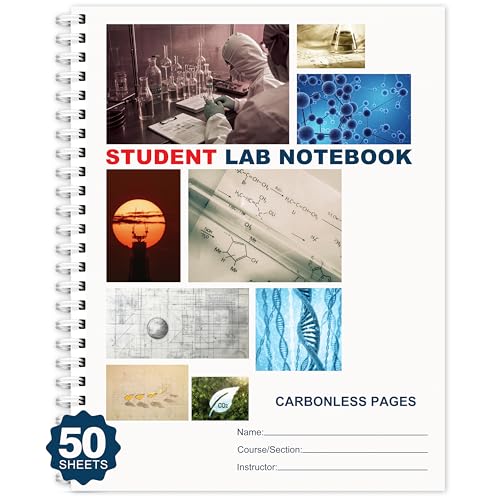
Features: carbonless copy notebook that generates duplicates without carbon paper, supporting efficient backup and sharing of lab notes. Includes scientific grid paper, a built-in periodic table, and dual measurement rulers. Wire-O binding lies flat for easy writing in wet or dry lab environments.
Best for: researchers and students who want built-in reference materials and precise diagramming capabilities on a durable, keep-flat page surface.
Limitation: may be priced higher than simple carbonless pads due to added reference features.
BookFactory Carbonless Lab Notebook

Features: Made in the USA with durable translucent cover; carbonless duplicate pages with a clearly labeled original and a perforated transfer page. Wire-O binding keeps pages secure and accessible during lab work. A veteran-owned, Ohio-made option emphasizing reliability.
Best for: professionals seeking a U.S.-made carbon copy notebook with robust construction and clear duplication pages.
Caution: may have fewer auxiliary features like grid lines depending on the exact model.
Affrolling 2 Pack Carbonless Lab Notebook

Features: two notebooks totaling 100 pages, with 50 pages of writing and 50 carbon pages each. White writing pages and yellow carbon pages for easy copy identification. Marble cover with personal information fields and 360° coil binding for flexible page use.
Best for: labs or classrooms requiring multiple copies and shared notes with streamlined duplicate records.
Limitation: bulkier than single-notebook options, which may affect portability.
Buying Guide: Carbon Copy Notebooks For Lab Work
What to look for when choosing
Copy quality: carbonless pages produce clean duplicates with minimal smudging. Look for pages labeled as carbonless or with self-copying features.
Binding and durability: Wire-O or coil bindings that lie flat are ideal for hands-on lab work. A durable cover protects notes in wet or crowded environments.
Page layout: grid or scientific grid pages help with diagrams and data tables. If you need quick copies of notes, ensure the carbon sheets are clearly differentiated (e.g., white/original and yellow/copy).
Size and portability: 8.5 x 11 inches is common for labs; smaller sizes fit pockets but may limit space for data-heavy entries.
Special features: built-in reference material (like periodic tables), acrylic sheets for copying accuracy, and 360° coil binding are valuable for complex experiments.
When to choose a kit vs. a single notebook
Choose a kit (multiple notebooks) if your lab produces a high volume of notes or requires backups for many projects. A single notebook is suitable for quick field work or personal record-keeping.
Accessibility and organization tips
Label notebooks with project names and dates. Use color-differentiated carbon pages to separate copies from originals. Maintain a simple filing system to centralize copy records.
Other considerations
Consider the environment (e.g., lab conditions) when selecting a notebook. Water resistance, cover protection, and page durability influence long-term note retention.
FAQ
- What is carbonless copy paper in notebooks?
Carbonless copy paper enables duplicates without the need for carbon sheets, producing a clean second copy as you write.
- Who should use carbonless lab notebooks?
Students, researchers, and professionals who need quick, verifiable backups of their lab notes and memos.
- What binding type works best for lab work?
Wire-O or coil bindings that lie flat are preferred for ease of writing on a tabletop and in tight spaces.
- Are color-differentiated pages important?
Yes. White originals and yellow copies help prevent confusion when sharing or filing records.
- Should I buy multiple notebooks?
Yes, if you generate many records or need copies for several collaborators. A pack saves time and ensures consistent formatting.