When selecting a burette stand and clamp system, look for stability, corrosion resistance, and versatility. This guide targets buyers who want reliable lab stands for titrations, distillations, and general wet chemistry. The top five products below are chosen for durability, adjustable clamps, and compatibility with a range of glassware up to 100–500 mL. The buyer types best suited for each option are noted to help you pick quickly.
| Product | Best For | Key Benefit |
|---|---|---|
| EISCO Double Burette Clamp Support with Rod | General titration setups | Sturdy jaws and long 24″ rod |
| EISCO Chemical Resistant Steel Ring Stand Set | Classroom and teaching labs | Comprehensive set with base, rod, clamp, and ring |
| QWORK Chemistry Laboratory Stands Set (2) | Flexible small-group experiments | Two stands with burette clamp and rings |
| VEVOR Lab Stand Support | Stable, durable long-term setups | All-metal construction with versatile clamps |
| QWORK Steel Laboratory Support Stand Set (16″ Rod) | Filtration and heating experiments | Solid base with multiple clamps |
EISCO Double Burette Clamp Support with Rod

EISCO’s double burette clamp is built around a stainless steel rod with alloy jaws, designed to hold burettes up to 100 mL. The 24″ rod length provides flexibility for vertical and angled placements, reducing the chance of spills during titration. Best for teaching labs and small to mid-sized burettes. A limitation is that the jaw size is tailored for up to 100 mL, so larger burettes require a different clamp.
EISCO Chemical Resistant Steel Ring Stand Set
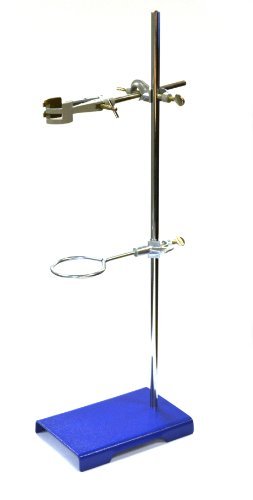
This set includes a blue powder-coated base, a 23.6″ rod, a 4-pronged clamp with a bosshead, and a metal retort ring. It’s designed for classroom use and lab setups that require a sturdy, all-in-one stand. Best for instructors needing a reliable kit with minimal assembly. It’s heavier and may require more desk space, which could be a consideration in small labs.
QWORK Chemistry Laboratory Stands Set

Two stands with a 16″ rod, burette clamp, and two retort rings provide a compact, flexible solution for small group experiments. The thick cast iron base offers a stable platform, helping minimize movement during measurements. Choose this if you need a pair of stands for paired experiments or demonstrations. A potential limitation is that the 16″ rod height may be restrictive for taller setups.
VEVOR Lab Stand Support

VEVOR combines a stainless steel rod with a cast iron base to deliver durable, rust-resistant performance. The base is stable, helping prevent tipping during experiments that involve heating or swirling reagents. It suits longer experiments and setups requiring stronger clamps. A caveat is that some users may find the base heavier to reposition in a crowded lab bench.
QWORK Steel Laboratory Support Stand Set

This 16″ rod set includes rings and a burette clamp, tailored for filtration, heating, and teaching tasks. The cast iron base provides steadiness, and the clamp variety supports different glassware diameters. Best for classrooms and hobbyist labs that perform multiple, lightweight operations. It may be less suitable for heavy, high-volume setups due to the smaller rod height.
Buying Guide
What should I look for in a burette stand and clamp?
Stability, material quality, and clamp versatility are key. Look for steel or cast iron bases, corrosion-resistant finishes, and clamps that accommodate your glassware’s diameter. A long, sturdy rod enables flexible placement and reduces the risk of tipping during titrations.
What rod length and base size are ideal?
Rod lengths between 16″ and 24″ cover most lab tasks. Bases ranging from 8″ x 5″ to larger sizes provide better balance for heavier setups. Choose according to bench space and the weight of your glassware.
Are PVC-coated jaws better?
PVC-dipped or coated jaws offer gentler grip on delicate glassware and reduce scratches. They’re ideal when handling thin walled flasks or burettes, but ensure the coating won’t delaminate under hot conditions.
Which setup suits teaching vs. research labs?
Teaching labs benefit from complete sets with multiple clamps and rings for quick, safe demonstrations. Research-oriented labs may prefer modular stands with robust bases and higher load capacity for varied glassware and apparatus.
What about compatibility with 100 mL burettes?
Many clamps are designed for burettes up to 100 mL. If you use larger burettes, verify the clamp’s jaw width and opening range. Spring-loaded clamps offer broader compatibility for irregular items.
Maintenance and care
Regularly wipe down metal surfaces to prevent corrosion. Check for loosened screws and ensure the rod remains straight. Lubricate threaded joints if required to maintain smooth adjustment.
Comparison snapshot
- Best for classroom versatility: EISCO Double Burette Clamp with Rod and EISCO Ring Stand Set
- Best for heavy-duty stability: VEVOR Lab Stand Support
- Best for paired experiments: QWORK Chemistry Laboratory Stands Set
- Best for precise small-bore glassware: EISCO Burette Clamp with Bosshead
- Best for filtration-focused setups: QWORK Steel Stand Set with Rings
Frequently Asked Questions
- What is the typical maximum burette size these stands support? Answer: Most clamps support burettes up to 100 mL, with some variants capable of larger items depending on jaw opening.
- Are these stands easy to assemble for beginners? Answer: Yes, many sets are designed for quick assembly with simple base, rod, and clamp attachment.
- Can I use these stands for hot glassware? Answer: Yes, many bases are cast iron or stainless steel; avoid direct contact with extremely hot glassware to protect coatings.
- Which stand offers the best value for a classroom? Answer: The EISCO Ring Stand Set provides an all-in-one solution with base, rod, and clamps for teaching labs.
- Do these stands require special storage? Answer: Store on a clean bench or dedicated rack to prevent corrosion and keep clamps organized.