For anyone setting up qualitative or quantitative filtration with a Buchner funnel, selecting the right filter paper is essential. This guide highlights five top filter papers that align with typical Buchner funnel applications, from qualitative analysis to rapid filtration. Best for students, researchers, and lab technicians, these options cover general-purpose papers, rapid filtration, and precise micron retention. The summary table below helps compare key specs at a glance.
| Product | ||||
|---|---|---|---|---|
| StonyLab Qualitative Filter Paper Circles, 94mm | 94 mm | 20 µm | 35 – 70 sec | General qualitative filtration on Buchner setups |
| StonyLab Qualitative Filter Paper Circles, 74mm | 74 mm | 20 µm | 35 – 70 sec | Smaller Buchner funnels, quick qualitative work |
| StonyLab Qualitative Filter Paper, 74 mm, 10 µm | 74 mm | 10 µm | 70 – 140 sec | Cleaner filtrates with finer retention |
| Zenpore 7 cm Qualitative Filter Paper, Grade 1 | 70 mm | Unknown/Grade 1 (qualitative) | Standard flow | Educational labs and qualitative separations |
| Zenpore 9 cm Qualitative Filter Paper, Grade 2 | 90 mm | 2 (qualitative grade) | Slow flow for turbidity removal | Soil, agricultural testing, or wort clarification |
StonyLab 94mm Qualitative Filter Paper Circles

Diameter: 94 mm. Retains particles > 20 µm; Filtration speed 35 – 70 sec. Best for larger Buchner funnels when moderate flow and qualitative separation are needed. Suitable for quick removal of visible particulates in liquid samples. Caution: slower flow may occur with very viscous liquids or dense slurries. Choose this if you need reliable, coarse filtration with easy handling in standard lab funnels.
StonyLab 74mm Qualitative Filter Paper Circles
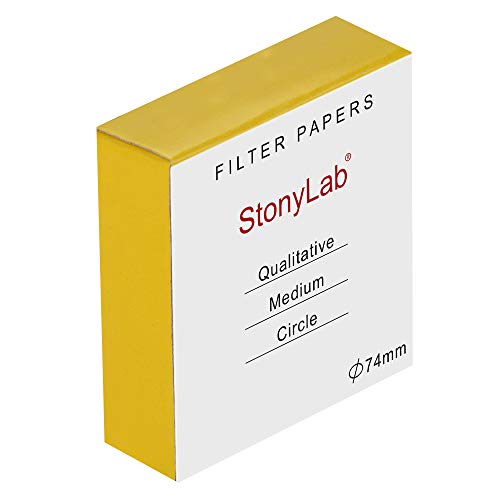
Diameter: 74 mm. Retains > 20 µm with filtration speed 35 – 70 sec. This size fits smaller Buchner funnels or desk-sized setups. Best for quick qualitative separations and routine lab filtration. Limitation: 74 mm papers may require precise alignment in tight funnels to prevent bypass. Choose this for smaller sample volumes or compact filtration stations.
Zenpore 7 cm Grade 1 Qualitative Filter Paper

Diameter: 70 mm; Grade 1 qualitative paper designed for standard faculty and student labs. Suitable for determining fat content and basic qualitative separations. Best for classroom demonstrations and routine qualitative filtering. Limitation: Grade 1 may not remove very fine particles as rapidly as finer grades; expect moderate clarity with typical organic samples. Choose this for educational use and basic qualitative tests.
Zenpore 9 cm Grade 2 Qualitative Filter Paper

Diameter: 90 mm. Grade 2 qualitative filtration suitable for soil pre-filtration, fertilizer testing, and wort clarification. Best for applications where slower flow helps capture turbidity and larger particulates. Caution: slower flow may extend filtration times in high-volume runs. Choose this when filtration clarity is a priority and you operate larger Buchner funnels.
Premium Filter Paper, 15 cm (100 Discs)

Diameter: 15 cm. Pore size 10 µm; High retentivity for qualitative analysis. Best for larger filtration needs with consistent flow across multiple discs. Limitation: 15 cm papers are larger and need correspondingly sized Buchner funnels. Choose this for broad, high-clarity filtration tasks and scalable experiments.
Buying Guide: Filter Paper For Buchner Funnels
What size and diameter do you need?
Match the filter paper diameter to the Buchner funnel opening. Common sizes include 70 mm, 74 mm, 90 mm, and 94 mm. Larger diameters increase filtration area and speed for bigger sample volumes, while smaller sizes fit compact setups.
What particle retention matters?
Retentivity is key for clarity and accuracy. Coarser papers (e.g., 20 µm) remove larger particles quickly, suitable for crude separations. Finer papers (e.g., 10 µm) yield cleaner filtrates but may slow flow. For qualitative analysis and turbidity removal, choose an appropriate compromise between speed and clarity.
How does flow rate affect your workflow?
Filtration speed indicates how fast filtrate passes through the paper. Slower flow can improve separation of fine particles but adds time to each run. For high-throughput tasks, seek papers with balanced flow (e.g., 35 – 70 sec) while retaining required particle sizes.
Material and quality considerations
All listed papers use cellulose filter media crafted for lab use. Grade designations (Grade 1, Grade 2) signal typical qualitative testing roles. If your process involves fats, solvents, or specific chemicals, check compatibility with the solvent profile and avoid papers that may degrade or shed fibers.
How to choose between qualitative vs. quantitative papers?
Qualitative papers emphasize clean separation and particle retention suitable for identifying the presence of substances. Quantitative papers often feature higher uniformity and larger surface areas for precise measurements. In Buchner-funnel workflows focused on presence/absence tests, qualitative papers usually suffice; for gravimetric determinations, consider papers optimized for quantitative analysis with consistent thickness and weight.
Practical tips for best results
- Rinse the funnel with a small amount of solvent to pre-wet the paper for even flow.
- Center the paper on the funnel to prevent bypass around the edge.
- Store unused discs in a clean, dry container to avoid contamination.
- Dispose of used papers according to your lab’s safety guidelines.
FAQ
- What is the most versatile paper for Buchner filtrations? – Papers with mid-range retention (around 20 µm) and moderate flow offer a good balance for many qualitative tasks.
- Can I use larger diameter papers on smaller funnels? – No; use papers that match the funnel opening to avoid bypass and ensure a proper seal.
- Is slower filtration always better? – Not necessarily; slower flow can improve clarity but reduces throughput. Choose based on your needs for speed vs. filtration quality.
- Are these papers suitable for educational settings? – Yes; several options (Grade 1 and Grade 2 papers) are commonly used in classrooms for basic qualitative separations.
- Do the papers react with common solvents? – Most cellulose papers are inert for standard lab solvents, but always check compatibility with your specific solvent or sample.