The best bird cage lighting fixture depends on whether you need UVB output, adjustable scheduling, or a bird-safe design for chewers. LUCKY HERP is a straightforward UVB combo kit, wemidels adds timer and brightness controls, and HappyBird uses UV-free full-spectrum LEDs for hookbills. The Arcadia kit includes a reflector and safety grill, while TobeBright combines UVB and full-spectrum LEDs with multiple settings. Compare the listed features below and choose lighting to suit your bird’s needs and your veterinarian’s guidance.
| Product | Best For | Standout Feature |
|---|---|---|
| LUCKY HERP Combo Kit | Simple UVB setup | Bulb, fixture, and cage mount |
| wemidels LED Light | Scheduled daily lighting | Timer and dimming |
| HappyBird Light | Hookbill households | Chew-resistant design and no UV |
| Arcadia PureSun Kit | Complete compact UVB kit | Reflector and safety grill |
| TobeBright UVB Light | Adjustable lighting modes | UVB levels and timer settings |
LUCKY HERP Bird Cage Lighting Fixture Combo Kit

This kit is best for bird owners seeking a basic fixture-and-bulb UVB setup. It includes a 20-watt compact fluorescent bulb described as producing 2.4% UVB and UVA, plus a bolt-through cage mount and safety guard. The independent one-touch switch and built-in ballast are intended to provide simple operation and flicker-free startup.
Why it stands out: The mount, guard, fixture, and bulb are provided together, reducing the need to source those components separately. Limitation: An adjustable timer is not listed, so owners who want automatic scheduling may prefer a model with timer controls.
wemidels Full Spectrum LED Bird Cage Light

This LED fixture is best for owners who want preset lighting schedules and adjustable brightness. Its 90 LED beads are described as providing even full-spectrum illumination. Three timer settings—3, 9, and 12 hours—can help make a daily routine easier to maintain, while 10 brightness levels and stepless dimming offer control over light intensity.
Why it stands out: It combines timer choices with fine brightness adjustment, unlike simpler switch-operated fixtures. Limitation: The listed features do not specify UVB output, so choose another option if UVB is specifically part of your veterinarian’s lighting plan.
HappyBird Full Spectrum LED Cage Light

HappyBird is best for owners of hookbills or other birds that may chew nearby equipment. The 24-inch light uses full-spectrum LEDs and is described as having a chew-safe design. Its light does not include UV, and the product is presented as glare-free and suitable for use at any distance. The listed photoperiod approach relies on connecting the fixture to a timer.
Why it stands out: The chew-resistant construction and UV-free design make it distinct from UVB combo fixtures. Limitation: A timer is not listed as included, and this light does not provide UVB.
Arcadia PureSun Compact Bird Lighting Kit
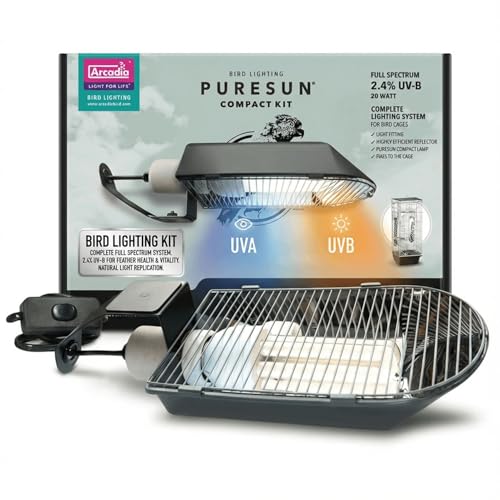
This kit is best for buyers who want a compact UVB fixture with several installation components included. The package features a 20-watt PureSun compact lamp, reflector, lamp holder, bracket, and safety grill. The listed output is 2.4% UVB and 30% UVA, with full-spectrum lighting intended for indoor bird habitats.
Why it stands out: The reflector and safety grill are part of the kit, and the UVA percentage is specified in the product details. Limitation: Timer controls are not listed, so automatic daily scheduling may require a separate timer.
TobeBright Dimmable UVB Bird Light

TobeBright is best for owners seeking more control over light modes and intensity. Its 32 full-spectrum LEDs work alongside 2.4 UVB LEDs, according to the product description. Three modes include full spectrum with UVB, UVB night light, and full spectrum only. A controller offers four intensity settings and a timer adjustable from 1 to 24 hours, with memory for settings after a power interruption.
Why it stands out: It offers more listed controls than a simple on/off fixture. Limitation: The multiple UVB settings may require careful selection; consult an avian veterinarian about appropriate lighting for your bird.
Buying Guide: How To Choose A Bird Cage Light
Do you need UVB or visible full-spectrum light?
These products use different approaches. UVB combo kits provide stated UVB output, while the HappyBird fixture is explicitly UV-free. Do not treat all “full-spectrum” lights as equivalent: check whether UVB is listed and discuss your bird’s requirements with an avian veterinarian before choosing a UVB source.
Would a timer or dimmer make daily use easier?
For preset schedules, the wemidels fixture offers 3-, 9-, and 12-hour timer modes. TobeBright allows timer settings from 1 to 24 hours and provides adjustable intensity. LUCKY HERP and Arcadia list simple fixtures and components but do not specify integrated timer controls.
What should you check about installation and chewing?
Compare included mounting parts, guards, and cable details. LUCKY HERP lists a bolt-through mount and safety guard; Arcadia includes a bracket and safety grill. HappyBird is specifically described as designed for hookbills and destructive chewers. Keep cords arranged safely and follow the fixture’s installation instructions.
Is a bird cage light a heat lamp?
Do not assume that a lighting fixture provides heat. The HOSUKKO product details explicitly state that its fixture cannot be used as a heating lamp. For any other model, check its documentation rather than using it as a heat source.
Frequently Asked Questions
Which bird cage light has a built-in timer?
The wemidels model lists 3-, 9-, and 12-hour presets. TobeBright lists a 1-to-24-hour timer with memory.
Which listed light is designed for birds that chew?
HappyBird is described as having a chew-safe design for parrots and other destructive chewers.
Do all full-spectrum bird lights provide UVB?
No. HappyBird is explicitly UV-free, while several other products list UVB output. Check the specific product details.
Should I choose a UVB fixture without veterinary advice?
Ask an avian veterinarian about your bird’s lighting needs and fixture setup. Product descriptions alone do not determine the appropriate lighting plan for an individual bird.