Many DIY and professional setups require a reliable 4″ to 3″ reducer to connect hoses, ducts, or vents of different sizes. This guide highlights five practical options, each suited to specific contexts like dust collection, ventilation, or dryer vent applications. The best pick depends on material, installation ease, and temperature tolerance. Below you’ll find clear, objective comparisons to help you choose the right reducer for your system.
| Product | Best For | Key Strength | Limitation |
|---|---|---|---|
| POWERTEC 70145 | Dust collection and woodworking | ABSlike durability with 4″ to 3″ reduction | Plastic ABS material limits high-temp use |
| Hon&Guan Galvanized Steel Reducer | Drier and venting environments | Metal construction, high-temp tolerance | May require clamps for a tighter seal |
| Marvexi ABS Reducer | General ventilation and HVAC linkages | Lightweight, easy installation | ABS plastic may have lower heat resistance |
| POWERTEC 70475 Flexible Cuff Kit | Sealed 4″ to 3″ connections | Flexible cuff for airtight fit | Includes only one reducer plus cuff; extra hardware may be needed |
| A-KARCK Stainless/Plastic Adapter | Low-profile duct transitions | Compact length with 3″ ID to 4″ OD | Lengthy notes required for compatibility |
POWERTEC 70145 4-Inch To 3-Inch Reducer
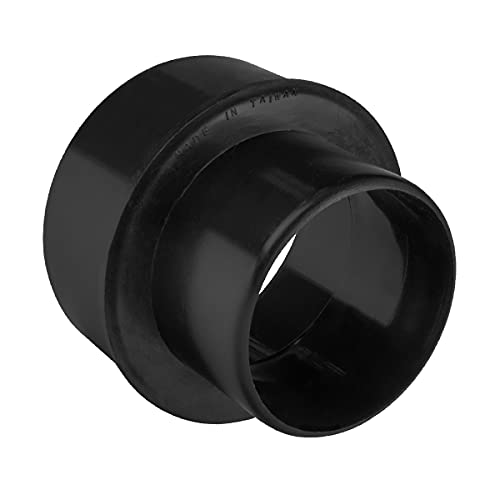
The POWERTEC 70145 reducer accepts a 4″ OD hose and steps down to 3″ to fit smaller lines or branches. Its ABS-style construction makes it suitable for dust collection systems and light-duty venting within safe temperature ranges. Best for: woodshop dust-collection lines and hobbyist setups where a simple, cost-effective transition is needed. Better for static ducting than high-temperature dryer vents. Caution: avoid prolonged exposure to temperatures beyond ABS recommendations (up to about 176°F / 80°C).
Hon&Guan 4 to 3 Inch Duct Reducer

This galvanized steel reducer transitions from 4″ to 3″ and is designed for high-temperature or dryer-vent environments. Best for: tougher installations where metal ducting is preferred for strength and heat resistance. The product notes that no tools are required for installation, and clamps (sold separately) can further tighten the seal. Caution: ensure proper fit with clamps to avoid leaks in critical air flow applications.
Marvexi 4 to 3 Inch Duct Reducer Adapter

Marvexi offers an ABS plastic reducer that supports 4″ to 3″ connections. It’s lightweight and straightforward to install, making it popular for general ventilation or air-flow projects. Best for: quick upgrades in non-temperature-critical settings. Choose this if you want a low-cost, easy-to-cut-and-fit option. Limitation: ABS plastic may not perform well under high heat or long-term UV exposure.
POWERTEC 70475 4-Inch to 3-Inch Reducer and Flex Cuff

This kit includes a flexible cuff and clamps along with a 4″ to 3″ reducer to create an airtight joint between 4″ and 3″ ports. Best for: setups requiring a sealed, flexible transition in dust collection or duct networks. The flexible cuff helps compensate for misalignment or vibration. Caution: verify the cuff dimensions (4-9/16″ OD, 4″ ID, 2-9/16″ length) align with your components to avoid gaps.
A-KARCK 3″ ID to 4″ OD Exhaust Adapter

Known as a compact reducer, this adapter transitions from 3″ inner diameter to 4″ outer diameter. Best for: tight spaces or applications where a short, discrete transition is needed. The overall length is 4.2 inches with a 1.37mm thickness, making it a space-saving choice. Caution: confirm compatibility with your exact hose or duct ID and OD to avoid loose connections.
Buying Guide
What material matters for a 4″ to 3″ reducer?
Material affects heat tolerance, rigidity, and durability. Plastic/ABS is lightweight and inexpensive but may warp under heat. Galvanized steel lasts longer in high-temperature environments but can require clamps for a tight seal. ABS may be suitable for general ventilation and dust collection within safe temperature ranges.
Will this reducer fit my system?
Check both the 4″ OD and 3″ ID measurements. Some reducers specify nominal sizes that differ from actual OD/ID. Look for compatibility notes and whether clamps or cuffs are included. Consider whether a flexible cuff improves airtightness in your setup.
Is a reducer better with clamps or a cuff?
Clamps provide a metal-to-metal seal, good for rigid ducts. Flexible cuffs can accommodate minor misalignment and reduce leaks in dynamic systems but require proper tightening to avoid looseness. Kits that include both can simplify installation.
What environments should you avoid?
Avoid low-temperature environments with plastics not rated for extended exposure to cold or humidity. For dryer vents or high-heat spaces, metal reducers are typically safer choices due to their thermal resilience.
How do I choose among the five options?
Choose POWERTEC 70145 for cost-effective dust collection in woodworking. Choose Hon&Guan for metal durability and higher-temperature scenarios. Choose Marvexi for a lightweight, general-purpose option. Choose POWERTEC 70475 when airtight flexibility matters. Choose A-KARCK for compact, space-saving transitions in tight installations.
Practical installation tips
- Dry-fit first to confirm alignment and length.
- Use clamps where recommended by the product to ensure a tight seal.
- Keep duct surfaces clean of debris to maintain airflow.
- Avoid overtightening to prevent damage to hoses or fittings.
Frequently Asked Questions
- What is a 4″ to 3″ reducer used for? It connects hoses or ducts of different diameters, typically from 4″ to 3″, for dust collection, ventilation, or exhaust systems.
- Can these reducers handle high-temperature dryer vents? Metal reducers are generally better for higher temperatures; plastic reducers have lower heat tolerance.
- Do these come with hoses or clamps? Some kits include clamps or cuffs; others may require separate purchase.
- Which material lasts longest in a workshop? Galvanized steel or other metal reducers typically offer greater durability in demanding environments.
- Is a flexible cuff necessary? A flexible cuff helps achieve an airtight seal when perfect alignment is hard to achieve or when vibration is present.
- How do I measure for compatibility? Measure the outer diameter of the 4″ hose and the inner diameter of the 3″ duct to ensure a proper match.