A 1958 wheat penny’s value depends mainly on its mint mark, condition, and whether it has a genuine mint error. Most circulated examples are common, while sharply preserved coins and verified errors may attract more collector interest. For a specific 1958 coin, the listed 1958 P&D set is best for comparing both mint marks, and the uncirculated 1958-D cent is better for collectors seeking a higher-condition example. The other picks provide mixed wheat cents for searching or filling a collection.
| Product | Best suited for | What to note |
|---|---|---|
| 1958 P&D two-coin set | Comparing the two mint marks | Good or better condition stated |
| 1958-D uncirculated cent | A single higher-condition example | Listing uses stock photos |
| 1909–1958 shotgun roll | Collectors who want mixed dates | Includes 49 wheat cents and an Indian Head cent |
| One-pound wheat penny assortment | Bulk collecting or sorting | Advertised as 148 unsearched coins |
| 1909–1958 grab bag | Exploring a mixed-date group | Unsearched listing; individual coins vary |
1958 P&D Lincoln Wheat Penny Two-Coin Set

Best for: Collectors who want one 1958 Philadelphia-mint cent and one Denver-mint cent together. The listing describes a two-coin set of 1958 P and D wheat pennies in good condition or better, making it a straightforward option for comparing the dates and mint marks in a coin book.
To identify each coin, check the obverse date and the area below it. A “D” indicates Denver; a coin without a mint mark was struck in Philadelphia. This set was selected because it directly covers both regular 1958 mint-mark varieties.
Limitation: The stated condition is broad, so the listing does not establish a precise grade or guarantee that either coin is uncirculated.
1958-D Uncirculated Mint State Wheat Cent

Best for: Buyers seeking a single Denver-mint 1958 cent described as uncirculated and mint state. The listing identifies the coin as a bronze Lincoln wheat cent and says the purchase is guaranteed to match the quality shown.
Condition is central to evaluating a wheat penny. Uncirculated coins have not circulated, but marks, color, and strike can still differ among individual pieces. This product was selected because its stated condition makes it more relevant to a buyer comparing a well-preserved 1958-D with circulated cents.
Limitation: The listing says its images are stock photos, so the pictured coin may not be the exact coin shipped. No specific numerical grade is provided in the supplied details.
1909–1958 Wheat Penny Shotgun Roll

Best for: Collectors who prefer a mixed group of older cents rather than a single 1958 coin. The listing describes 50 cents in a shotgun roll: 49 wheat cents dated within 1909–1958 and one Indian Head cent at the end.
This roll may suit someone building a date collection or sorting wheat cents for mint marks and condition. It was selected because its stated date range includes 1958, alongside earlier Lincoln cents. However, the listing does not promise a particular number of 1958 coins or a particular mint mark.
Limitation: Choose this if variety matters more than receiving a specific 1958 penny. The contents are mixed, so it is not a targeted way to obtain a particular 1958 variety.
One-Pound Wheat Pennies Assortment
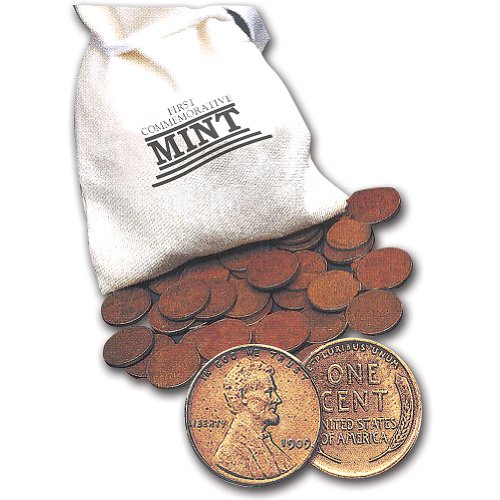
Best for: Hobbyists who want a larger group of wheat pennies to sort, study, or use as collection fillers. The product name describes one pound and 148 unsearched coins. A bulk assortment can offer more opportunities to examine dates and mint marks than buying a single cent.
This option was selected for buyers interested in searching a mixed lot that may include wheat cents from the relevant era. “Unsearched” is a listing description, not a guarantee that the coins contain a rare date, valuable error, or any specific 1958 penny.
Limitation: The supplied features do not specify the exact date distribution, mint marks, or condition of the individual coins. Avoid this if you need a guaranteed 1958 example.
1909–1958 Lincoln Wheat Penny Grab Bag

Best for: Collectors who want a one-pound, mixed-date lot of Lincoln wheat pennies. The listing describes the coins as an unsearched grab bag covering 1909–1958 and notes that the condition is good. Its date range includes 1958, making it relevant for collectors who enjoy checking a group for dates and mint marks.
This product was selected as a bulk alternative to the single-coin 1958 options. It is better for browsing a varied assortment than for completing a specific 1958 slot.
Limitation: The product details do not specify how many coins are included or how many are from 1958. The stated date range does not mean every date is represented.
Buying Guide: How To Evaluate A 1958 Wheat Penny
Which 1958 mint mark should you check?
Look below the date on the front of the coin. A “D” identifies a Denver-minted cent; no mint mark identifies a Philadelphia-minted cent. The mint mark helps describe the coin, but it does not alone determine value. Condition and demand also matter.
How does condition affect value?
Circulation wears down design details, while uncirculated coins retain more original detail. Examine Lincoln’s hair, the wheat ears on the reverse, and the lettering for wear. Avoid cleaning a coin to make it look brighter; cleaning can alter its surface and affect collector appeal.
What can make a 1958 cent more collectible?
Exceptional preservation or a genuine mint error may make a coin more interesting to collectors. Confirm unusual features carefully: damage after minting can resemble an error. For a potential high-value variety, compare the coin with reliable numismatic references or seek an expert evaluation before assigning a value.
Should you buy a single coin or a mixed lot?
Choose a single 1958 coin or the P&D set when you need a specific date and mint mark. Choose a mixed roll or pound assortment when sorting and variety are part of the appeal. Bulk listings do not guarantee a 1958 coin or a rare find unless the seller explicitly states that detail.
Frequently Asked Questions
Are all 1958 wheat pennies valuable?
No. Value varies with condition, mint mark, collector demand, and any verified error. A circulated coin is not automatically rare because of its date.
How do I tell whether my 1958 penny is from Denver?
Look for a small “D” below the date on the front. If there is no mint mark, the coin is from Philadelphia.
Does “uncirculated” mean a coin has a high grade?
Not necessarily. It indicates that the coin is described as not circulated, but individual coins can still differ in marks, luster, and strike. A specific grade requires a more precise assessment.
Can a wheat penny assortment guarantee a 1958 coin?
Not unless the listing specifically guarantees one. A date range that ends in 1958 means that 1958 coins may be included, not that a particular assortment contains one.