Answering the common buyer question: which 100 ml graduated cylinder best fits your needs? This article highlights five top options and explains who each cylinder is best for, from classroom projects to professional labs. Suitable for students, technicians, and researchers seeking reliable measurement tools with clear graduations and stable bases.
| Product | Material | Base Type | Tolerance |
|---|---|---|---|
| EISCO Plastic 100 ml | Polypropylene | Octagonal | Class B |
| EISCO 100 ml Borosilicate Glass | Borosilicate 3.3 | Flat/Base | Class A |
| EISCO ASTM Class A 100 ml | Borosilicate 3.3 | Protective Collar | Class A |
| Karter Scientific 100 ml | Borosilicate 3.3 | Hexagonal Base | Class B |
| QWORK 100 ml Glass | Borosilicate 3.3 | Base with Bumper Guards | Class Not Specified |
EISCO Plastic Graduated Cylinder, 100ml

Material: polypropylene plastic; capacity: 100 ml; tolerance: Class B. Features an octagonal base for maximum stability and raised 1 ml graduations readable through the translucent wall. Calibrated to contain. This model is best for quick, lightweight measurements in teaching labs or field work where durability matters more than chemical resistance.
Best for: budget-conscious classrooms or makerspace labs needing a tough, autoclavable-grade plastic cylinder without glass breakage risk. Caution: plastic can be less resistant to certain solvents compared with glass.
Graduated Cylinder, 100ml – Class A Borosilicate Glass
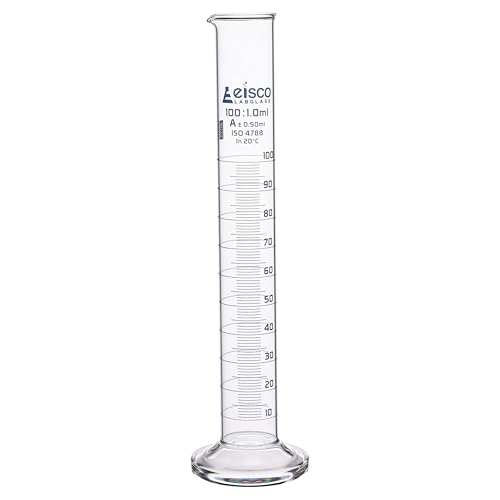
Material: Borosilicate 3.3 glass; capacity: 100 ml; tolerance: Class A. Blue graduations with 1 ml subdivisions. Calibrated to contain. This cylinder suits precise measurements in professional labs and advanced classrooms, offering clear visibility and strong chemical resistance.
Best for: higher-precision tasks and DIN/ISO-compliant setups. Limitation: glass base is heavier and can be more prone to chipping if mishandled.
ASTM Class A 100 mL with Protective Collar

Material: Borosilicate 3.3 glass; capacity: 100 ml; tolerance: Class A. Features a protective collar and a hexagonal base for stability. Blue graduations with 1.0 ml subdivisions. This option is well-suited for labs requiring ASTM-compliant tolerances with added protection against accidental drops.
Best for: controlled lab environments where durability and compliance matter. Caution: protective collar adds size and can interfere with tight storage in compact setups.
Karter Scientific 100ml Graduated Cylinder

Material: Borosilicate 3.3 glass; capacity: 100 ml; graduations: 1 ml; tolerance: +/- 1 ml. The cylinder uses a hexagonal base for stability and clear, single-metric markings. This is a reliable choice for standard lab work and educational demonstrations requiring consistent readings.
Best for: labs needing straightforward, durable glass with readable 1 ml increments. Limitation: tolerance is +/- 1 ml, which is wider than Class A tolerances.
GSHLLO 100ml Plastic Graduated Cylinder
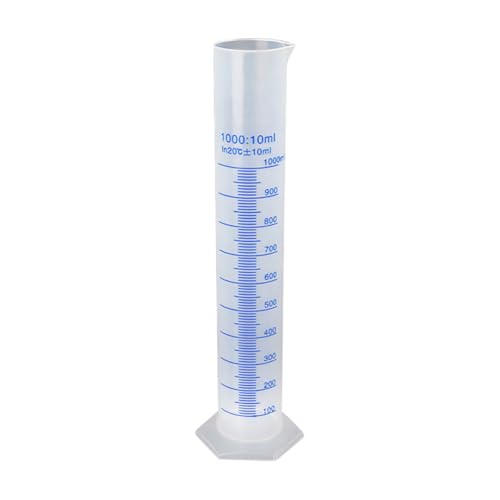
Material: plastic; capacity: around 100 ml; features blue line graduations; hexagonal base for stability. The design allows clear viewing of the liquid level through the wall. Suitable for light-duty tasks, home labs, or classroom projects where breakage risk is a concern.
Best for: quick, safe handling in educational settings and nonhazardous experiments. Caution: plastic tolerances may vary with heat and chemical exposure; avoid aggressive solvent use.
EISCO Premium Graduated Cylinder Set

Set includes 50 ml, 100 ml, and 250 ml borosilicate glass cylinders. Class A tolerance; protective collars; hexagonal bases for maximum stability. Designed for professional laboratories but also suitable for classrooms and home science projects.
Best for: users needing a versatile, multi-capacity set with robust glass for ongoing experiments. Limitation: bulkier storage and higher cost than single-cylinder options.
Buying Guide: Key Considerations For 100 ml Graduated Cylinders
- Material choice: Glass (borosilicate 3.3) offers chemical resistance and clear visibility; plastic is durable and lighter but may have higher tolerances and chemical limitations.
- Base design: Hexagonal or octagonal bases improve stability; a protective collar can guard against drops but adds size.
- Tolerance and accuracy: Class A tolerances are tighter (often ±0.50 ml) versus Class B (often ±1.0 ml). Select based on required measurement precision.
- Graduation readability: Raised or colored graduations aid quick reading; ensure markings are clearly printed and calibrated to contain.
- Intended use: Educational settings benefit from sturdy plastic options; professional labs prioritize glass with tight tolerances and chemical resistance.
- Care and maintenance: Glass cylinders may require careful handling and occasional cleaning; plastic cylinders can be autoclavable in some cases, depending on material.
Frequently Asked Questions
- What is the difference between Class A and Class B tolerances?
Answer: Class A tolerances are tighter and meet stricter accuracy standards, while Class B tolerances are wider, suitable for less precision-critical tasks. - Are plastic graduated cylinders suitable for chemical use?
Answer: They are generally good for non-corrosive liquids and educational settings; check solvent compatibility for specific plastics before use. - Which base design provides the best stability?
Answer: Hexagonal or octagonal bases provide greater stability and reduce tipping compared with flat bases, especially on flat benches. - Is a protective collar important?
Answer: A protective collar damps impact and protects glass from chipping during impacts or drops; it can be beneficial in classrooms and early labs. - When should I choose a multi-cylinder set over a single cylinder?
Answer: A set is advantageous for teaching multiple experiments or when different volumes are frequently needed; it also simplifies procurement for a classroom. - What should I consider for storage and handling?
Answer: Look for cylinders with stable bases and consider space for vertical or horizontal storage, avoiding stacked heavy items to minimize breakage risk.