The best choice depends on the hazard: a respirator labeled P100 offers at least 99.97% filtration efficiency for specified particulates, while vapor protection requires the right cartridge. The 3M 65021 is best for certain organic vapors and particulates; the 3M 2097-based respirator is best for particulate-heavy tasks such as mold or lead paint removal. AirGearPro’s G-500 combines vapor and dust filters, while the half-face and full-face options offer different coverage. The listed products do not all claim HEPA filtration, so verify the filter rating and intended use before buying.
| Product | Best suited for | Key filter information |
|---|---|---|
| 3M 65021 | Organic vapors plus particulates | NIOSH-approved P100/organic vapor combination |
| AirGearPro G-500 | Painting, sanding, and renovation | A1P2 system; P2 filter claims at least 98% particle filtration |
| 3M P100 Mold & Lead Paint Respirator | Particulate-focused work | NIOSH-approved P100 filters |
| Reusable Half Face Respirator | Buyers seeking a reusable half-face design | Filter rating not specified in the provided details |
| Full Face Organic Vapor Respirator | Buyers wanting eye and face coverage | Two cartridges included; rating details not provided |
3M 65021 P100/Organic Vapor Respirator

Best for: People who need particulate filtration along with protection from certain organic vapors. This medium-size reusable respirator includes a NIOSH-approved organic vapor/P100 combination cartridge. Its P100 filter provides at least 99.97% filtration efficiency against solids, liquid aerosols, and oil-based particulates.
The included particulate filters are oil-proof, subject to the manufacturer’s time-use restrictions when oil aerosols are present. The listing also identifies relief from certain non-harmful particles and annoying odors as a use. It is a strong option when both particle and specified vapor hazards matter.
Limitation: Organic vapor protection applies to certain vapors, not every chemical. Check the cartridge’s approved use and replacement guidance for the specific hazard.
AirGearPro G-500 A1P2 Respirator

Best for: Buyers doing tasks such as painting, woodworking, sanding, construction, or renovation who want a reusable mask with included safety goggles. Its A1P2 dual filtration system is described as filtering organic vapors with boiling points above 65°C and airborne particles.
The P2 dust filter is listed as filtering at least 98% of airborne particles. The design allows filter replacement when filters reach the end of their service life. Choose this if the stated A1P2 protection matches the work; it is a different rating from the P100 products in this guide.
Limitation: The listing states CE certification, but does not identify this product as NIOSH-approved. Its stated particle filtration is at least 98%, not the 99.97% listed for P100 filters.
3M P100 Mold And Lead Paint Respirator

Best for: Particulate-focused tasks including professional mold or lead-based paint removal, woodworking, and fiberglass insulation work. The listing specifies a NIOSH-approved 3M 2097 P100 particulate filter with at least 99.97% filtration efficiency against solids, liquid aerosols, and oil-based particulates.
A carbon layer helps reduce nuisance odors from organic vapors, including certain solvents, degreasers, and resins. That feature is described as odor reduction; it should not be treated as proof of protection from hazardous vapor concentrations. This is the better fit when P100 particulate filtration is the central requirement.
Limitation: The carbon layer is for nuisance odor reduction, not a substitute for a cartridge selected for a specific vapor hazard.
Reusable Half Face Respirator With Filters
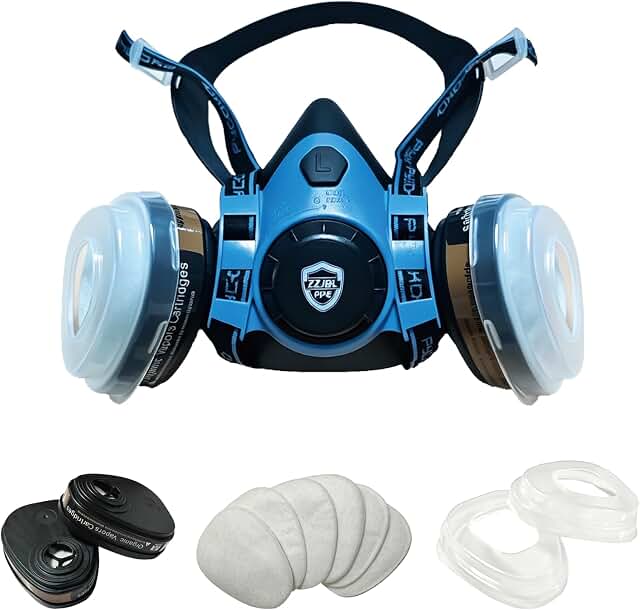
Best for: Buyers looking for a reusable half-face design with adjustable straps and replaceable dual filters. The product description highlights soft, skin-friendly material, a lightweight design, and low breathing resistance for extended wear. These details may be useful when comfort and ongoing filter replacement are priorities.
Choose this if you want a simple half-face format and can confirm that its filters are suitable for your work. The listing says the filters are high-efficiency but does not provide a named filter class or a specific filtration percentage.
Limitation: Do not assume it provides HEPA, P100, or vapor protection without verifying the filter specification and intended use.
Full Face Organic Vapor Respirator

Best for: Buyers seeking a full-face style with eye and nose coverage. The product name describes an anti-fog heavy-duty lens, adjustable fit, and two included filter cartridges. This design may suit people who want more facial coverage than a half-face respirator provides.
Limitation: The provided product details do not state a filter rating, approval, or which specific vapors and particles the cartridges address. Confirm those specifications before selecting it for a hazard.
Buying Guide: How To Choose A Respirator Filter
Do you need particle or vapor protection?
Match the respirator to the hazard. P100 filters are specified for particulates and are listed here with at least 99.97% filtration efficiency. Organic vapor cartridges address certain vapors, but the exact chemical and exposure conditions determine whether a cartridge is suitable. A particulate filter alone does not establish vapor protection.
Is P100 the same as HEPA?
No. P100 is a NIOSH filter classification, while HEPA refers to a separate filtration standard. The products in this list are not all described as HEPA-filter respirators. If you specifically need HEPA, verify the exact filter designation and that it is approved for the respirator model rather than relying on a general “high-efficiency” description.
Should you choose a half-face or full-face model?
A half-face respirator covers the nose and mouth; the listed full-face option also has a lens intended to cover the eyes. Choose based on the protection required by the task and the equipment’s documented specifications. A full-face design does not by itself confirm a particular filter rating or hazard approval.
What should you check before use?
- Verify the filter or cartridge rating and the hazards it is intended to address.
- Confirm that replacement filters are specified for the exact respirator.
- Follow the manufacturer’s fit, use, and replacement instructions.
- Check whether oil aerosols or particular vapors affect filter use limits.
Frequently Asked Questions
Which listed respirator has the clearest P100 specification?
The 3M 65021 and the 3M P100 Mold & Lead Paint Respirator both list NIOSH-approved P100 filtration with at least 99.97% efficiency for specified particulates.
Does P100 protect against organic vapors?
P100 describes particulate filtration. Vapor protection requires a suitable chemical cartridge, such as the organic vapor/P100 combination listed for the 3M 65021.
Is the AirGearPro G-500 a P100 respirator?
The provided details identify it as an A1P2 system, with a P2 filter listed at least 98% particle filtration. They do not identify it as P100.
Can any of these respirators be called HEPA?
The supplied product details do not identify these models as HEPA respirators. Check the specific filter designation and equipment documentation if HEPA is a requirement.