The best orange 3D printer filament depends on whether you prioritize speed, strength, a smooth everyday printing experience, or a distinctive finish. eSUN PLA Basic suits fast-printing projects, SUNLU PLA+ 2.0 is a stronger-material option, and 3DHoJor offers another high-speed choice. ELEGOO PLA is a straightforward option for general-purpose prints, while Miailuy Silk is worth considering when appearance is the priority. The five picks below are 1.75 mm filament intended for FDM printers.
| Filament | Best For | Standout Detail |
|---|---|---|
| eSUN PLA Basic | Fast printing | Designed for improved flow |
| SUNLU PLA+ 2.0 | More durable PLA+ | Advertised speeds up to 300 mm/s |
| 3DHoJor High-Speed PLA | Speed and stated settings | Recommended temperature of 215°C |
| ELEGOO PLA | Everyday prints | Accuracy of +/- 0.02 mm |
| Miailuy Silk PLA | Decorative prints | Silk-style orange filament |
eSUN PLA Basic For Fast Printing

eSUN PLA Basic is best for buyers who want orange PLA intended for high-speed printing. The manufacturer describes it as an improved PLA formula with better fluidity and fast-printing performance. It is listed as compatible with many FDM printers, including several Bambu Lab, AnkerMake, Creality, Prusa, and UltiMaker models.
The product information also cites low shrinkage, low odor, reduced stringing, and resistance to warping and cracking. These properties make it a useful candidate for general creative prints as well as projects where faster production is desirable. Choose this spool if you want a speed-focused PLA with broad stated printer compatibility.
Limitation: The listing does not provide a specific recommended nozzle temperature or a numeric maximum print speed, so check your printer’s settings and run a calibration print.
SUNLU PLA+ 2.0 For Tougher Prints

SUNLU PLA+ 2.0 is best for buyers who want a PLA+ option described as more resistant to brittleness and cracking than standard PLA+. The maker also says the material melts quickly and flows smoothly, with support for printing speeds up to 300 mm/s. Its 1 kg spool provides a practical amount for multiple projects.
This filament is positioned for both beginners and experienced users, so it may suit a household or workshop that wants a tougher alternative to basic PLA without moving to another material category. Choose it when durability claims and high-speed capability matter more than choosing a standard PLA formula.
Limitation: The supplied product details do not list a nozzle temperature or printer compatibility examples. Confirm your machine’s material guidance before using the advertised top speed.
3DHoJor High-Speed PLA With Settings

3DHoJor is best for buyers who want high-speed PLA with specific suggested printing parameters. The listing gives a recommended temperature of 215°C within a 190–230°C range, a 45–60°C bed temperature, and a recommended speed range of 40–300 mm/s. It also states dimensional accuracy of +/- 0.03 mm.
The product is described as mechanically wound to reduce tangles and overlaps, and its compatibility examples include Bambu Lab, AnkerMake, Voron, Raise3D, Prusa, and Creality Ender printers. These details make it easier to compare against a printer’s requirements before purchase. Choose this spool if published setup guidance is important.
Limitation: The 300 mm/s figure is an upper advertised capability, not a guaranteed result on every printer or model. Start with settings suited to your machine.
ELEGOO PLA For Everyday Projects
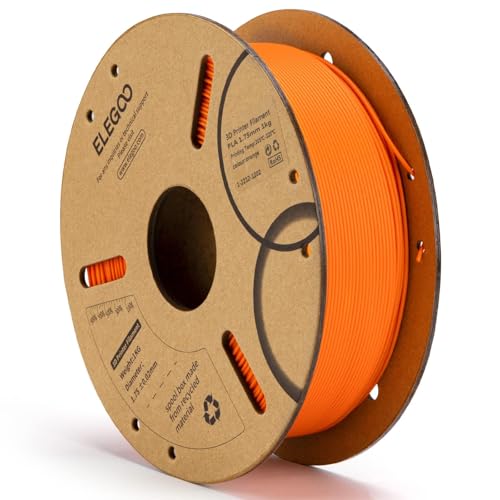
ELEGOO PLA is best for buyers seeking general-purpose orange filament with a stated diameter accuracy of +/- 0.02 mm. The product details describe low melting temperature, low warping and shrinkage, and a glossy surface finish. Its 1 kg cardboard spool is listed as suitable for most FDM printers.
Neat winding and a larger spool inner diameter are also highlighted as features intended to support feeding and reduce tangling. Choose this option for everyday decorative or functional prints when a standard PLA profile and consistent filament diameter are priorities.
Limitation: The provided information does not specify a recommended printing temperature or speed. Use the filament guidance available for your printer and adjust as needed.
Miailuy Silk Orange For Decorative Prints

Miailuy Silk is best for buyers choosing orange filament for appearance-led prints. The product name identifies it as silk filament, while the listed details provide a 190–230°C nozzle range and a 50–60°C heated-bed range. The maker also describes low warping, minimal odor, and compatibility with a range of FDM printers, including Creality, Ender, Prusa, and Artillery models.
The spool is described as vacuum-sealed with desiccant, a packaging detail intended to protect it from moisture before use. Choose this product for decorative objects where a silk-style filament is more relevant than a high-speed specification.
Limitation: The listing does not provide a numeric maximum printing speed. Follow the temperature guidance and test the material on your printer.
Buying Guide: How To Choose Orange Filament
Should you choose PLA or PLA+?
Standard PLA is a practical choice for general projects and straightforward printing. PLA+ may be preferable when the product is specifically marketed for improved toughness or resistance to brittleness. For example, SUNLU PLA+ 2.0 is described as more resistant to brittleness and cracking. These are manufacturer claims, so match the material to the project rather than assuming every PLA+ behaves identically.
Is high-speed filament right for your printer?
Compare the filament’s stated speed with your printer’s capabilities and your chosen print profile. eSUN emphasizes improved flow for fast printing, while 3DHoJor gives a range up to 300 mm/s and a recommended starting temperature. An advertised maximum does not guarantee that every design will print well at that speed.
Why check filament diameter and winding?
All five products are 1.75 mm filament. Check that this matches your printer’s required filament diameter before ordering. Stated accuracy and neatly wound spools can help you compare products, but proper storage, printer setup, and feeding also matter.
Which option is best for decorative prints?
Consider the finish named in the product description. The Miailuy option is identified as silk orange, while ELEGOO describes a glossy surface finish. Color appearance can vary with lighting, display settings, and print conditions, so the listing image is not a guarantee of an exact shade.
Frequently Asked Questions
What filament diameter do these orange products use?
All five selected products are listed as 1.75 mm filament. Verify your printer’s required diameter before purchasing.
Which orange filament is best for faster printing?
eSUN PLA Basic and 3DHoJor High-Speed PLA are speed-focused options. 3DHoJor provides a stated speed range up to 300 mm/s, while eSUN highlights improved fluidity for fast printing.
Which option is described as more resistant to cracking?
SUNLU PLA+ 2.0 is described as more resistant to brittleness and cracking compared with standard PLA+.
Do these filaments fit every 3D printer?
No product should be assumed to fit every printer. The listings describe compatibility with many FDM printers, but confirm that your machine supports 1.75 mm filament and the material’s requirements.
What is the best choice for silk-style orange prints?
Miailuy Silk is the selection specifically identified as silk orange filament. Its listing provides nozzle and heated-bed temperature ranges for setup.