The best German language learning tools match the skill you want to practice: choose vocabulary cards for recall, phrase cards for conversation, and stickers for everyday word exposure. The five options below include dedicated German vocabulary decks, present-tense verb practice, travel phrases with audio, and labeled stickers. They suit different study styles, from structured drills to quick practice at home or on the go.
| Tool | Best For | Standout Feature |
|---|---|---|
| Resurhang German Flash Cards | Present-tense verb practice | Conjugations with English translations |
| Oh Yup German Phrase Cards | Beginners practicing speech | Pronunciation and QR-code audio |
| VocabularyStickers German Stickers | Learning around the home or office | Color-coded German articles |
| gisgfim German Vocabulary Cards | Portable vocabulary review | 300 German-focused cards |
| Travelflips German Flash Cards | Travel situations | Words in sentences with phonetic pronunciation |
Resurhang German Verb Flash Cards

These cards are best for learners who want focused present-tense verb practice rather than a broad vocabulary deck. The set contains 200 cards across Portuguese, German, French, and Italian, so it is not exclusively German. Check that multilingual format suits your study plan before choosing it.
Each card presents an infinitive, tense category, and example sentence on the front. The reverse includes English translations and complete present-tense conjugation forms. At 2.8 by 3.9 inches, the cards are designed for portable review. The coated, laminated surface and double-sided format support repeated handling and active recall.
Oh Yup German Conversational Phrase Cards

These 75 cards are best for beginners who want to rehearse useful phrases and pronunciation. Topics include greetings, introductions, daily life, hobbies, and class. Each card includes an English translation and pronunciation, while QR codes provide access to audio—helpful for learners who want to hear phrases as well as read them.
The compact deck can be used for self-study, classroom activities, pronunciation drills, or travel preparation. Choose it if speaking practice is a priority. Its scope is conversational phrases, so learners seeking extensive grammar instruction or a large general vocabulary collection may want a second resource.
VocabularyStickers German Learning Stickers

These stickers are best for learners who benefit from seeing German words during daily routines. The set contains 132 bilingual German-English labels, each with a keyword and icon. Colors distinguish the articles: blue for der, red for die, and orange for das. This makes the stickers a practical supplement for noticing nouns and their grammatical articles.
Place them around a home or office to create repeated visual reminders. Choose this format if you prefer environmental exposure to scheduled card drills. The listed features describe vocabulary stickers, not a complete course, so they should be paired with other practice for speaking, listening, and grammar.
gisgfim German Vocabulary Flash Cards

This 300-card set is best for learners who want a German-focused deck for portable vocabulary practice. The cards are double-sided and measure 2.48 by 3.46 inches, making them suitable for carrying in a bag or pocket. The product description also identifies German verb conjugation practice as part of the set.
Thick cardstock and curved edges are listed as features for frequent handling. Choose this deck if you want a larger collection dedicated to German rather than a multilingual set. The supplied details do not specify the vocabulary categories or provide a card-by-card contents list, so review the product information if you need a particular topic range.
Travelflips German Travel Flash Cards
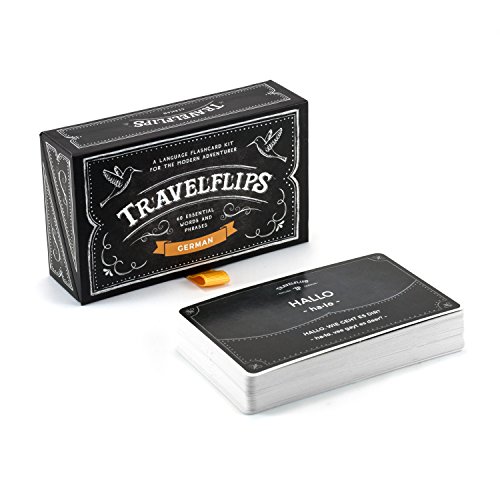
Travelflips is best for travelers who want practical words presented in context. Each card includes a German word and short sample sentence on the front, with English translations and phonetic pronunciation on the back. The described situations include greeting people, ordering food, and asking for directions, with five proverbs also included.
The product mentions use across Germany, Austria, and Switzerland. Choose it if travel-ready vocabulary matters more than broad grammar coverage. Because the listed focus is travel situations, it may be less suitable as a standalone resource for learners seeking systematic lessons in sentence structure or verb conjugation.
Buying Guide: How To Choose German Learning Tools
Which skill do you want to improve?
For verb forms, choose a deck that explicitly includes conjugations, such as Resurhang. For everyday vocabulary, compare the larger gisgfim deck with the sticker set’s 132 labeled words. For speaking preparation, Oh Yup combines phrases, pronunciation, and QR-code audio. Travelflips focuses on travel contexts and words used in sample sentences.
Do you learn better through repetition, context, or audio?
Flash cards support focused recall: cover the answer, retrieve it, and check the reverse. Context-rich cards connect words with example sentences. Audio access can add a listening component, while stickers put words in view during daily activities. These formats are different tools, not interchangeable substitutes; choose the one that addresses your current study gap.
Will you study at home or on the go?
Compact cards are suited to short review sessions during commutes or travel. Stickers are intended for placement around a home or office instead. Consider whether you want a reusable deck you can carry, a visual reminder in a fixed location, or a mix of both. Also check card dimensions and the described contents before buying.
Should one tool be your entire study plan?
Most products here focus on a particular task, such as vocabulary, phrases, or present-tense verbs. A balanced routine can combine a card deck with listening, speaking, reading, and grammar practice. Use these tools to reinforce material rather than assume any single product covers every aspect of German.
Frequently Asked Questions
What is the best German learning tool for beginners?
The best choice depends on the beginner’s goal. Oh Yup is oriented toward essential conversational phrases, while vocabulary cards and stickers focus on words and recall.
Which option includes German pronunciation support?
Oh Yup includes pronunciation and QR-code audio access. Travelflips provides phonetic pronunciation on its cards.
Which product focuses on German verb conjugation?
Resurhang includes present-tense conjugation forms, and the gisgfim product description also identifies verb conjugation practice.
Are German learning stickers enough to study the language?
No. The stickers provide bilingual vocabulary and article-color cues, but the listed features do not cover a complete language curriculum.
Which tool is designed for travel vocabulary?
Travelflips focuses on practical travel situations, including greetings, food orders, and asking for directions.