The best full-page large grid paper depends on whether you need a spacious drafting surface or standard letter-size sheets for a binder. The 22-by-17-inch Yaridar pads are best for large diagrams and layouts, while Geyer’s 8.5-by-11-inch ream suits everyday classroom or office use with a finer 1/6-inch grid. For binder-ready pages, choose the Yaridar graph filler paper. The options below compare size, grid description, format, and stated sheet count so you can match the paper to your work.
| Product | Size and grid | Best for |
|---|---|---|
| Geyer Classic Graph Paper | Full sheet, 1/6-inch squares | Detailed work and large-volume use |
| Yaridar Engineering Graph Paper Pad | 22 x 17 inches, 4 x 4 blue grid | Large drafting layouts |
| Yaridar Large Engineering Graph Paper | 22 x 17 inches, 4 x 4 blue grid | Engineering and design projects |
| Yaridar Large Engineering Graph Pad | 22 x 17 inches, 4 x 4 blue grid | Oversized desk-pad use |
| Yaridar Graph Filler Paper | 8.5 x 11 inches, 4 x 4 blue grid | Three-hole binders and classes |
Geyer Classic Full-Page Graph Paper

Geyer Instructional Products’ ream provides 500 sheets of full-sheet graph paper with blue 1/6-inch squares. The grid is printed on both sides, and the pages are three-hole punched for binder storage. Blue lines provide a visible reference while leaving the page available for plotted data, sketches, or class notes.
Best for: Students, teachers, and offices that need a large supply of standard full-page graph sheets with a comparatively fine grid. It stands out for combining double-sided printing, binder holes, and a 500-sheet quantity.
Consider: The 1/6-inch squares are smaller than the described 4-by-4 grid on the large Yaridar pads, so this is better for detailed plotting than broad, oversized layouts.
Yaridar 22-by-17-Inch Graph Desk Pad
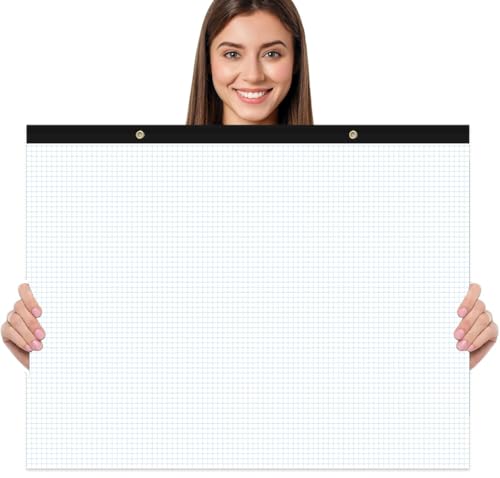
This oversized pad measures 22 by 17 inches and has a blue 4-by-4 quad rule. It includes 50 sheets, listed as 100 pages, and uses 100 gsm acid-free paper. The sheets are perforated for removal, while a 1200 gsm backer supports the pad on a desk. The listing says the paper is intended for use with most pens, pencils, and markers without ghosting or bleed-through.
Best for: Architects, engineers, designers, and students who need room for large sketches or working diagrams. Choose this if a tear-off desk pad is more useful than compact binder sheets.
Consider: At 22 by 17 inches, it requires substantially more workspace than letter-size paper.
Yaridar Large Engineering Graph Paper

This 22-by-17-inch pad is another large-format option for drafting, sketching, and diagram work. Its listed specifications include a blue 4-by-4 grid, 50 sheets or 100 pages, and 100 gsm acid-free white paper. Perforated sheets are designed for neat removal, and the sturdy backer helps protect the desktop while writing.
Best for: Buyers who want a large grid surface and a pad format for engineering, architecture, mathematics, or design tasks. Its listed size and paper features make it comparable to the other Yaridar oversized pads.
Consider: The product description gives the grid as “4 x 4” but does not clarify a smaller unit measurement. Confirm that the grid spacing suits your project before choosing it for scaled work.
Yaridar 22-by-17-Inch Engineering Graph Pad

This Yaridar pad is listed at 22 by 17 inches and features a blue 4-by-4 quad rule. Its 100 gsm acid-free paper is described as suitable for most pens, pencils, and markers, with reduced ghosting and bleed-through. Perforations help remove sheets, and a 1200 gsm backer provides a firm base for desk use.
Best for: Draftsmen, designers, and other users who want an oversized pad for repeated drawing or planning. It shares the large format and stated paper construction of the other Yaridar pads.
Consider: The supplied feature list does not state the sheet count, so check the product listing if quantity is important to your purchase.
Yaridar Three-Hole Graph Filler Paper

This letter-size option measures 8.5 by 11 inches and has a blue 4-by-4 quad rule. The 100-sheet pack is described as 200 pages, and the paper is three-hole punched for standard three-ring binder inserts. The listing says it does not fit six-ring binders.
Best for: Students and office users who want grid paper stored alongside other notes in a standard three-ring binder. Choose it over a desk pad when portability and page organization matter more than a large drawing area.
Consider: It is standard letter size, not an oversized full-page drafting pad, and the listing specifically excludes six-ring binders.
Buying Guide: How to Choose Full-Page Grid Paper
Should you choose oversized or letter-size paper?
Choose a 22-by-17-inch pad for large diagrams, layouts, or sketches that need room to spread out. Choose 8.5-by-11-inch sheets for classroom work, everyday notes, or binder storage. A larger sheet can be harder to store and use on a small desk.
Which grid spacing is right for your work?
Grid spacing affects how much detail fits on a page. Geyer specifies 1/6-inch squares, making the measurement clear for users who need a fine grid. The Yaridar listings describe a 4-by-4 blue grid or quad rule without clarifying the unit in the supplied details. Verify the spacing if accurate scaling matters.
Do you need loose sheets or a tear-off pad?
A ream or punched filler paper is useful when sheets need to be filed in a binder. A desk pad keeps oversized sheets together and offers a backing for writing, while perforations support removal. Compare sheet count as well as format: the Geyer ream lists 500 sheets, and two Yaridar large-pad listings specify 50 sheets.
Frequently Asked Questions
What is the largest graph paper option listed here?
The Yaridar engineering pads measure 22 by 17 inches, making them the largest options in this selection.
Which option has the finest specified grid?
Geyer specifies 1/6-inch squares. The Yaridar products describe a 4-by-4 grid but do not give a smaller unit measurement in the supplied details.
Which graph paper is three-hole punched?
The Geyer full-page ream and Yaridar 8.5-by-11-inch graph filler paper are listed as three-hole punched.
Can the Yaridar filler paper go in a six-ring binder?
No. Its listing states that it does not fit six-ring binders, though it is described for standard three-hole inserts.
Are the large Yaridar pads suitable for markers?
The product descriptions say the 100 gsm paper can be used with most pens, pencils, and markers and is designed to reduce ghosting and bleed-through.