The best blue lens welding helmets combine eye protection, true color viewing, and versatile shade options. This guide highlights five models that balance blue-light blocking performance with clear visibility for TIG, MIG, MMA, cut, and grind work. Suitable buyers include professionals needing extended sessions, hobbyists prioritizing eye comfort, and those who work outdoors where sensor reliability matters. Below is a quick comparison table to help you decide at a glance.
| Product | Best For |
|---|---|
| YESWELDER Auto Darkening Welding Helmet (Blue Light Blocking, 2 Arc Sensors) | All-around TIG/MIG/ARC and grinding, budget-friendly |
| YESWELDER Large View Auto Darkening Welding Helmet (4 Arc Sensors) | Tall viewing area, outdoor or bright-light environments |
| Miller Digital Elite Auto-Darkening Helmet | High-end clarity and productivity tracking |
| YESWELDER Large View Auto Darkening Helmet (LED Light, 4 Sensors) | Low-light tasks with built-in illumination |
| YESWELDER Auto Darkening Helmet (Blue Light Blocking, Large View) | Wide shade range with strong blue-light protection |
Each option emphasizes blue-light blocking and a true color view to reduce eye strain. All are solar-powered with auto-darkening filters, and most accommodate magnifying lenses for close-up work. The following sections provide concise, product-specific details to help you choose.
YESWELDER Auto Darkening Welding Helmet (Blue Light Blocking)

Best for general-purpose welding with a focus on eye protection and color clarity. This helmet offers a 3.5/9-13 shade range and a 3.64″ x 1.67″ viewing area with true-color optics. It supports TIG, MIG, MMA/ARC, and grinding, and can accept magnifying lenses for detail work. The blue light blocking outer lens helps reduce eye strain during long sessions. Caution: with 2 arc sensors, sensor responsiveness is adequate but not the most advanced option for extreme outdoor glare.
YESWELDER Large View Auto Darkening Helmet (4 Sensors)
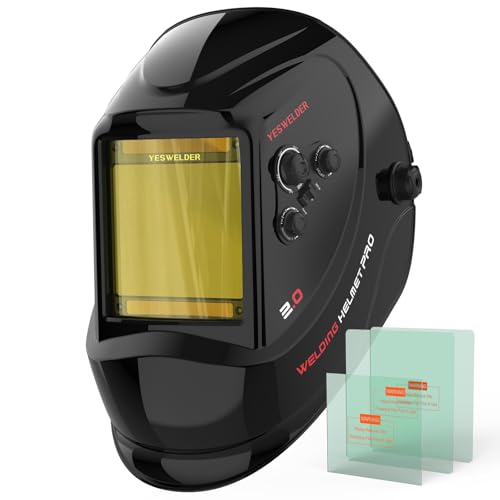
Best for welders who value a larger view and advanced eye protection. It features blue light blocking technology and a large 3.93″ x 3.66″ view with 1/1/1/1 optical clarity. The wide shade range 3/5-9/9-13 covers TIG, MIG, MMA, cutting, and grinding. It includes four arc sensors for improved reliability in challenging setups. Choose this if you need a bigger field of view and stronger protection in bright outdoor conditions. Limitation: higher price and bulk compared to basic models.
Miller Digital Elite Series Auto-Darkening Helmet
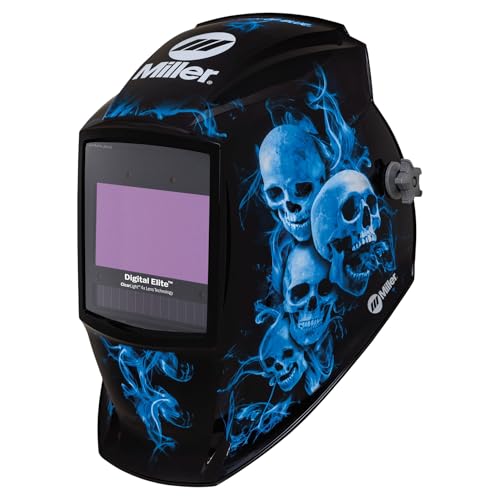
Best for professional welders seeking advanced monitoring and productivity metrics. ClearLight 4x Lens Technology provides high-definition, brighter views across weld stages. Four independent arc sensors offer superior lens response in obstructed or low-amp welding, and X-Mode reduces sunlight interference for outdoor use. InfoTrack 2.0 tracks arc time and arc count for efficiency analysis. This helmet is ideal for project-driven shops needing precise usage data. Caution: higher complexity may require a learning curve for new users.
YESWELDER Large View Auto Darkening Helmet (LED Light)

Best for dim environments and tasks that require extra visibility. This helmet adds a removable adhesive LED light with two brightness levels, aiding close-up welding in dark spaces. It maintains blue-light blocking protection and a wide shade range of 3/5-9/9-13 for TIG, MIG, MMA, cutting, and grinding. Magnifying lens compatibility is supported. Caution: LED light attachment may require periodic replacement of the adhesive mounting for best performance.
YESWELDER Auto Darkening Helmet With Blue Light Blocking

Best for versatile projects needing strong blue-light protection and a large viewing area. It offers a 3/5-9/9-13 shade range, four arc sensors, and a 3.93″ x 3.66″ viewing window. The blue-light blocking outer lens reduces eye strain during extended welds, while the true-color view enhances puddle definition. This model balances protection with readability for professional use. Limitation: may feel heavier than compact models during long shifts.
Buying Guide
What to consider when choosing a blue lens welding helmet
Eye protection is the priority. Look for blue light blocking outer lenses, true color optics, and sufficient viewing area to reduce eye fatigue during long sessions. A larger viewing window improves puddle visibility and reduces head movement.
Shade range and process compatibility
Most welds require a shade range of 3/5-9/9-13. Verify compatibility with TIG, MIG, MMA, cutting, and grinding. A wider range provides flexibility across tasks without swapping helmets.
Arc sensors and sensors reliability
More sensors generally improve lens response, especially when reflections or grinding cause sensor occlusion. Four sensors are common in higher-end models and outdoor work.
Magnifying lenses and customization
If you use magnifying lenses, ensure the helmet supports magnifier inserts. Not all models accommodate them equally, and some require adapters.
Power, durability, and ergonomics
Solar-powered configurations reduce battery maintenance. Consider weight and balance for all-day wear. Durable shells and clear-lens technology minimize distortion and extend lifespan in workshop conditions.
Special features and extras
Blue light blocking is a key feature for eye comfort. Optional LED lighting can help in low-light environments. Tracking and monitoring features may aid professional productivity, though they add cost and setup considerations.
Frequently Asked Questions
- What is the benefit of blue light blocking on welding helmets? It reduces exposure to high-energy blue light, potentially lowering eye strain during long welding sessions.
- Do all blue lens helmets have the same viewing area? No. Viewing areas vary; larger windows provide better puddle visibility but may affect weight. Compare dimensions before purchasing.
- Can I use magnifying lenses with these helmets? Many support magnifying lenses, but compatibility varies. Check the product specifications or manufacturer guidance.
- What determines sensor performance in bright outdoor conditions? Sensor counts (four vs. two), the inclusion of X-Mode or similar outdoor aids, and shielding from direct sunlight influence performance.
- Is a model with LED lighting worth it for dim shops? LED lighting helps illuminate the weld zone in dark spaces, improving task accuracy but adds a feature to consider if you frequently weld in low light.
- Why choose a helmet with a larger viewing area? A larger view reduces head movement and improves puddle definition, which can increase precision in complex welds.