Find reliable, easy-to-install push-to-connect fittings rated for RO water systems. This guide focuses on 3/8″ to 1/4″ tube connections, ideal for quick, leak-resistant joins. Best-suited buyers include DIY homeowners, plumbers looking for fast installs, and installers seeking durable fittings for tubing in RO setups. The selections below emphasize compatibility, ease of use, and long-term seal integrity.
Overview of top picks at a glance:
| Product | Brand | Size (Tube OD) | Best For |
|---|---|---|---|
| E-outstanding Quick Straight Connector | E-outstanding | 1/4″ to 3/8″ | Users needing a simple, tool-free connection for RO setups |
| John Guest Speedfit Reducing Union | John Guest | 3/8″ to 1/4″ | Leak-free, tool-free connections with EPDM O-rings |
| Sankoly Quick Connect Fittings | Sankoly | 1/4″ to 3/8″ | Durable, leak-proof quick-connects for RO systems |
| Zjxed Direct Push Reducing Hose Fittings | ROZESAZZ | 3/8″ to 1/4″ | Pack of 10, flexible push-to-connect options |
| YZMSZ Reducing Straight Union | YZMSZ | 1/4″ to 3/8″ | Value pack for RO water filters and quick installs |
E-outstanding Quick Straight Connector

Product details: PP material, strong and durable, pressure resistant, long service life. Small and flexible with easy installation and disassembly. A professional pipe cutter is recommended to reduce leakage when connecting PE pipes. No tools needed; simply insert the tube for a quick connect or disconnect.
Best for: DIY homeowners and installers who want a fast, tool-free connection for RO tubing. Why selected: Combines durability with straightforward usage and minimal equipment. Caution: Use a proper cutter to minimize leakage on certain pipe types.
John Guest Speedfit Reducing Union

Product details: Push-to-connect reducing union designed for copper or plastic tubing. No tools required and features EPDM O-rings for a reliable, leak-free connection using John Guest’s push-fit technology.
Best for: Professionals and serious DIYers who value a proven push-fit system with strong seals. Why selected: Notable for tool-free operation and dependable leak resistance. Caution: Precision sizing matters to ensure correct fit with existing lines.
Sankoly Quick Connect Fittings

Product details: Durable PP material; 6.5mm to 9.5mm inner diameter range with 1/4″ to 3/8″ tube compatibility. Silicone seals at both ends provide a leak-proof connection and resistance to temperatures 0-45°C.
Best for: Systems requiring robust, leak-proof connections with broad compatibility. Why selected: Good balance of material strength and ease of use. Caution: Ensure correct orientation to maximize seal integrity.
YZMSZ Reducing Straight Union
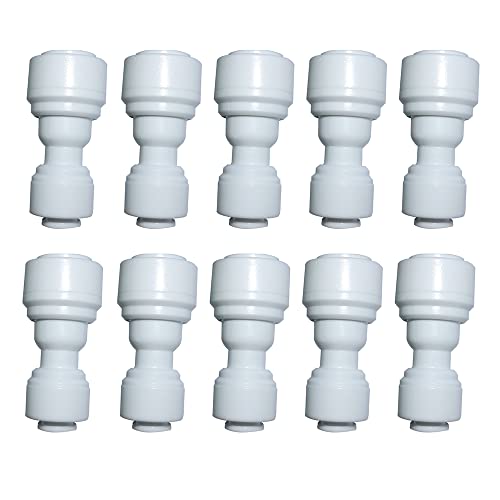
Product details: Food-grade material with Push to Connect technology. Reducing straight union, 1/4″ O.D. × 3/8″ O.D. Pack of 10 for RO water filters. Note: Designed for quick, tool-free connections without locking clips.
Best for: Budget-conscious projects needing multiple identical fittings. Why selected: High value with straightforward installation. Caution: Pack quantity may exceed immediate needs; store properly to avoid loss.
ROZESAZZ 1/4 to 3/8 Pneumatic Quick Connect

Product details: Plastic and stainless steel construction; 3/8″ Tube OD × 1/4″ Tube OD. Push-to-connect with a straight reducer design; sold as a pack of 10.
Best for: Installers needing ready-to-use reducing fittings in RO lines. Why selected: Durable materials and straightforward push-to-connect mechanism. Caution: Plastic components may have lower temperature tolerance in extreme conditions.
Malida Straight Connector

Product details: 1/4″ tube OD × 3/8″ stem OD; tool-free push-to-connect design. Works with copper or plastic tubing and supports permanent or removable leak-proof connections. Features a 90-degree elbow for angled routing.
Best for: Installations requiring an angled path between components. Why selected: Flexibility with a compact elbow design. Caution: Check tubing diameter and elbow clearance in tight spaces.
Buying Guide
Key considerations when choosing 3/8″ to 1/4″ push-to-connect fittings for RO systems:
- Compatibility: Verify tube outer diameter and material (PP, plastic, stainless) and ensure it matches your system’s tubing.
- Connection method: Push-to-connect fittings eliminate tools but require clean, deburred tubing for a reliable seal.
- Temperature and pressure: Most fittings handle typical household RO temps; confirm maximum pressure and temp ranges for your setup.
- Seal quality: Silicone or EPDM O-rings improve leak resistance; check end seals on both sides for durability.
- Quantity and spacing: If replacing multiple lines, choose packs that minimize waste and ensure easy future access.
- Material choice: PP or plastic fittings offer light weight and corrosion resistance; metal variants may provide higher durability in demanding environments.
- Installation notes: Some fittings benefit from professional cutting tools to minimize leakage on PE or other polymer pipes.
FAQ
- Q: Are push-to-connect fittings universal for RO tubing? A: They fit common 1/4″ to 3/8″ tube sizes, but check exact outer diameter and material compatibility with your RO system.
- Q: Do I need tools for installation? A: Many are tool-free; some may benefit from a pipe cutter for cleaner cuts and tighter seals.
- Q: Can these fittings handle hot water? A: They are designed for typical RO system temperatures; avoid exposing to high heat beyond rated limits.
- Q: How many fittings should I buy? A: Consider the number of RO connections in your system plus a few spare units for future repairs.
- Q: What is the main advantage of reducing unions? A: They allow adapting different tube sizes within a single, compact fitting, reducing clutter and potential leaks.
- Q: Are there any notable downsides? A: Some plastic fittings may be less robust under mechanical stress or in high-traffic areas; handle with care.